Deepor Beel Bird Sanctuary Guide for 2026

Before you drive down NH 27 toward Pamohi and Garchuk, before the road narrows and the fields open up into that first flash of silver water, here is what almost nobody tells you about Deepor Beel. Most visitors arrive expecting only a bird count. Few know that the lake's own fishing families still read the wind before they cast a net, that the wetland has a second name whispered in at least four tribal tongues, or that the single best hour to be here costs nothing and appears on no brochure. It is the half hour just after the country boats push off at dawn, when the mist has not yet lifted off the water and the hills of Rani and Garbhanga still wear their blue haze. Carry binoculars if you own a pair, but do not let them replace your own eyes for that first quarter hour. It is also worth knowing, before you go, that entry can sometimes be arranged informally with local boatmen near Pamohi rather than only through the forest department gate, that the eastern side of the beel is where the pollution is worst and birding is comparatively poorer, and that the western and southern fringes near the Rani reserve forest are where the elephants still come down at night. None of this appears on the standard tourist page. All of it changes how you experience the place.
Quick facts before you scroll further
- Location: about 15 km southwest of central Guwahati, Kamrup Metropolitan district, Assam
- Status: Assam's only Ramsar wetland, listed in November 2002, notified as a wildlife sanctuary in 1989
- Core protected area: 4.14 sq km, within a larger wetland spread that can widen to around 40 sq km in flood season
- Birdlife: over 219 recorded species, more than 70 of them migratory, several globally threatened
- Best months: October through March, coinciding with the arrival of winter migrants
- Boat rides: informal country boats, generally in the range of Rs 100 to Rs 200 for a couple of hours, best arranged directly with local boatmen
The name and its story
Say the name slowly. Deepor Beel. In Assamese, beel simply means a lake, one of those soft wide words that carries the sound of water in it. Deepor is the part scholars still argue about. Many trace it to the Sanskrit dipa, meaning elephant, so that the full name reads as the lake of elephants, a fitting title for a wetland that has fed wild herds from the Rani and Garbhanga forests for longer than anyone can date. A second, less repeated theory holds that the word grew not from one language but from several stitched together over centuries. Bodo, Karbi, Garo, Rabha and Khasi communities all settled this shoreline at different points in history, and Deepor may simply be what happens when five tongues describe the same elephant over enough generations that the word stops belonging to any single one of them. There is a gentler tale too, passed down among older residents, of a thirsty wandering Brahmin priest whose blessing is said to have called the lake into being. Nobody expects you to believe it literally. Everyone who tells it wants you to feel the reverence behind it.
The elephants themselves offer a quieter, more practical explanation for why they keep returning here every winter rather than folklore. As the dry season tightens its grip on the Rani and Garbhanga hill forests and the smaller seasonal streams there run thin, the herds descend toward the one water source that rarely fails them. The lake does not summon the elephants through any magic. It simply outlasts every other option nearby, which over enough winters starts to look a great deal like devotion.
The lake gave the elephants their name, and the elephants gave the lake its meaning. Long after the tourists leave, that exchange continues undisturbed in the dark, somewhere near the tree line.
A morning on the water
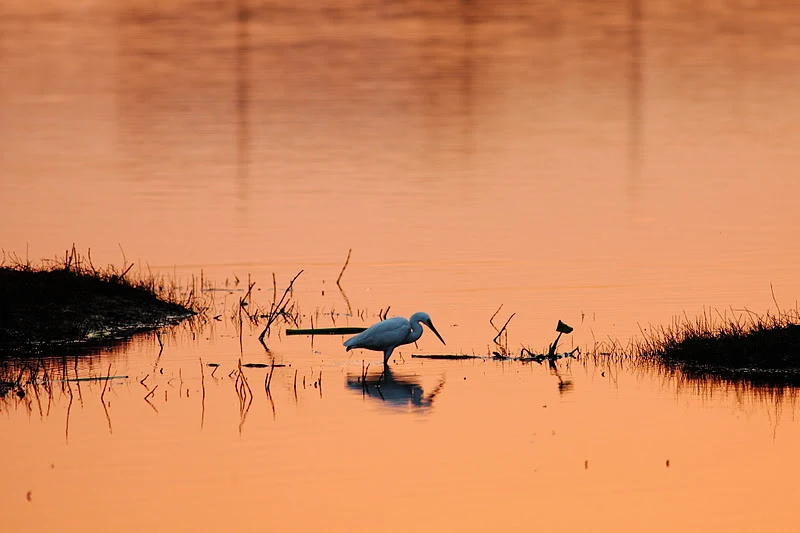
I came in October once, before the migratory flocks had properly arrived, and the beel wore only its resident quiet. The water held a blue so complete it seemed to have borrowed the sky's own colour and improved on it. Old trees leaned in from the banks, their branches nearly brushing the surface, and a single wooden boat sat half abandoned among the reeds like a sentence someone had left unfinished. There is a particular kind of stillness here that has nothing to do with silence. Egrets stood on bare stumps at a distance. Somewhere a water fowl picked its way through the shallows with the unhurried gait of something that has never needed to rush. To sit under a tree with a book, or with no book at all, is to understand why people from Guwahati keep returning to a place they can technically see from a passing train window.
By afternoon the light changes character completely. Water hyacinth and water lilies drift in patient clusters. Aquatic grasses rest in what can only be described as a whisper, submerged plants swaying just beneath a surface gone glassy with heat. Orchids and half wild medicinal plants crowd the banks in a tangle no gardener planted and no gardener maintains. It is not manicured. That is precisely its appeal.
Birds, tribes and the fishing life most visitors never meet
Ornithologists have logged well over two hundred species here, ducks and pond herons, cormorants and pelicans, storks that stalk the margins on legs like folded umbrellas, and raptors that circle high enough to be mistaken for drifting specks. Winter is when the numbers swell dramatically, when tens of thousands of birds can be present across a single day, some of them species found almost nowhere else in the region. But the sanctuary's other residents rarely make it into travel photographs. Wild elephants from the Rani and Garbhanga reserves still come down at night to drink and feed, and locals speak of leopards, wild boar and even the occasional big cat passing through the wilder southern fringe. Fish sustain an entire economy here. Communities such as the Kewat of Keotpara in Azara, along with Karbi and Rabha households from nearby villages, have depended on the beel's waters for generations. Roughly twelve hundred families across a cluster of villages draw a living directly or indirectly from what the lake provides.
Here is a detail that rarely surfaces outside specialist writing. Local fishing communities read the wind before deciding whether to fish at all. A wind blowing in from the west, known locally as posua botah, is believed to stir and cleanse the water in a way that scatters the fish, so boats stay docked until it passes. Around late October, villagers build a temporary bamboo screen structure called khar bheta or khar bandh across the Khanajan channel, the passage that connects the beel to the Brahmaputra, to keep fish from escaping the lake before the season's catch. During the monsoon the same barrier is opened so fresh fish can swim in from the river. There is also a strict, community enforced ban on fishing during the breeding season, because as one longtime resident put it, to fish then is to finish themselves along with the fish.
Not far from the beel, the Rabha community of Satargaon marks johong puja, a ritual devoted to honouring the beauty and providence of the natural world around them, wetland included. During Magh Bihu, Assam's harvest festival, community fishing becomes both a livelihood ritual and a social occasion, one more thread in a culture where songs and folk stories have long celebrated the region's beels.
The bird once feared, now revered
Among the birds that call Deepor Beel home permanently rather than passing through, one stands taller than the rest in every sense, the greater adjutant stork, a towering scavenger with a bald head and a strange, dangling neck pouch that locals named hargila, meaning bone swallower. For generations across Assam, this bird was not admired. It was feared. Its scavenging habits and unusual appearance earned it a reputation as a bad omen, and villagers routinely felled the very trees it nested in, treating its presence as something to be driven away rather than welcomed. Deepor Beel, along with a handful of nearby villages, remains one of the last strongholds on earth for this species, home to a meaningful share of a global population that now numbers only around twelve hundred birds.
What changed was not the bird but the story told about it. A wildlife biologist named Purnima Devi Barman grew up watching these superstitions destroy nesting colonies near Guwahati, and rather than fight the folklore directly, she rewrote it. She gathered local women into a group that came to be called the Hargila Army, and turned the stork into a subject of songs, weavings and community celebration instead of dread. Baby showers are now held for stork chicks. Sweets are prepared and offered to local deities before being shared among the crowd, and the same bird once stoned out of village trees now appears on ceremonial headdresses made to show off its strange beauty rather than hide it. It is one of the rare instances anywhere of a community actively rewriting its own folklore in real time, in service of a bird that most tourists never learn to look for. If you spot one wading through the shallows of Deepor Beel, know that you are looking at both an endangered species and a small, ongoing act of cultural repair.
Spirits of the wetland dark
Assam's wetlands, forests and elephant corridors have never existed only as physical geography in the local imagination. They sit inside a much older layer of belief, one that gives water bodies like this a kind of watchfulness that maps do not record. Assamese folklore is thick with such presences. Bordoisila, spoken of as the goddess of storms, is said to sweep through in the season of Bohag Bihu on her way to visit her mother's home, and older residents across the state still read sudden gusts through paddy and wetland alike as her passing rather than mere weather. Burha Dangoriya appears in village memory as a protective elder spirit tied to community prayer halls, a guardian rather than a threat. Bira spirits, described in older tellings as entities that cohabit with people and do the bidding of whoever commands them, belong to a darker register of the same belief system, invoked historically in stories of rivalry and retribution rather than comfort.
Wetlands, forest edges and elephant paths across Assam have long been treated as places where such presences linger more easily than in the open city, and a visitor who already knows these names carries a fuller sense of the imaginative world that surrounds a place like this, long before the Ramsar Convention ever gave it a formal designation.
The battle the water remembers
Long before Ramsar listings and forest department signage, this stretch of water played a quieter role in Assam's military history. Local accounts describe Deepor Beel serving as a dockyard used both by the Ahom kingdom and, at times, by Mughal forces, its shifting seasonal waters offering natural cover and obstacle alike. During the historic Battle of Saraighat, the rise and fall of waters in this general stretch of the Brahmaputra valley is said to have helped Ahom forces outmanoeuvre a larger invading army. There are no surviving inscriptions to prove every detail, but the oral history persists with a confidence that feels earned. Standing at the water's edge with that story in mind changes the way the lake looks. It stops being scenery and starts feeling like a witness.
Little known fact
Deepor Beel is the only Ramsar designated wetland in the entire state of Assam, despite the state having dozens of ecologically significant beels.Little known fact
The wetland acts as Guwahati's principal natural stormwater basin, meaning its slow decline directly increases the city's own flood risk.Little known fact
Birdlife International has separately recognised the area as an Important Bird Area, a distinction layered on top of its Ramsar status.Plan your visit
One honest note before the checklist. Recent visitor accounts through 2026 are mixed on boating. Some describe fishermen still renting out small country boats informally near Pamohi, while others report the forest department has restricted or paused organised boating altogether and now limits access to the watchtower and viewpoint. This kind of on ground detail changes month to month faster than any guide can track, so treat the boating option as possible rather than guaranteed, and confirm with the forest department office or a local boatman on arrival rather than planning around it in advance.
Practical notes for 2026 travellers
| Best time to visit | October to March, for peak migratory bird activity and cool, dry weather. Open year round otherwise. |
| Timings | Generally 9 AM to 5 PM, though this is set locally and worth confirming on the day. |
| Getting there | About 15 km southwest of central Guwahati via NH 27 through Garchuk and Pamohi. Roughly 15 km from Guwahati airport, under an hour by road depending on traffic. |
| Entry and permits | Some visitors report needing a basic entry permit from the forest department point. Carry ID and confirm current rules at the gate rather than assuming free walk in access. |
| Boat rides | When available, informal country boats have historically cost around Rs 100 to Rs 200 for a couple of hours. Availability is inconsistent in 2026, so confirm locally first. |
| Transport back | The area is remote with limited cab availability. Visitors without their own vehicle should arrange a return cab in advance or combine the trip with other stops nearby. |
| What to carry | Binoculars, a hat, mosquito repellent, snacks and water. Food options near the sanctuary are limited. |
| Best days | Weekday mornings are quieter for birding. Winter weekends draw large picnic groups whose noise scatters the birds. |
Nearby places worth combining with your trip
Since the sanctuary itself rewards a focused hour or two rather than a full day, most visitors pair it with other stops along the same route. Pobitora Wildlife Sanctuary, known for its rhino density, lies further east and suits a full separate day trip. Closer by, Guwahati's temple circuit, including Kamakhya Temple, Ugratara Temple and Basistha Ashram, works well either before or after a Deepor Beel morning. Chandubi Lake, a similar wetland further south, appeals to travellers who want a quieter, less encroached alternative on the same trip.
Leave Deepor Beel the way its oldest visitors describe leaving it, quietly, and a little changed. It asks for very little in return for what it gives, a slower pulse for an hour, a lesson in how a city and a wetland can share a single boundary without either one fully winning. Whether you come for the birds, the folklore, or simply the water's particular blue, give it the hour it deserves. Few places this close to an airport offer so much for so little effort.
Frequently asked questions
- What is Deepor Beel famous for?
- It is Assam's only Ramsar listed wetland, recognised for hosting over 200 recorded bird species, functioning as an elephant corridor from the Rani and Garbhanga reserve forests, and serving as Guwahati's main natural flood buffer.
- What is the best time to visit Deepor Beel?
- October through March is considered ideal, when migratory birds arrive in large numbers and the weather stays cool and dry. The sanctuary remains accessible throughout the year.
- How far is Deepor Beel from Guwahati city and airport?
- The wetland lies approximately 15 km southwest of central Guwahati and roughly the same distance from Lokpriya Gopinath Bordoloi International Airport, generally reachable within an hour by road.
- How much does a boat ride cost at Deepor Beel?
- Local country boats are generally available for around Rs 100 to Rs 200 for a couple of hours, arranged directly with boatmen rather than through a fixed ticketing counter.
- Is Deepor Beel safe and clean to visit?
- The western and southern sections remain scenic and relatively unaffected, while the eastern side has suffered notable pollution in recent years. Visitors are advised to check recent local reports before planning a boat route.
- What does the name Deepor Beel mean?
- Beel means lake in Assamese, and Deepor is widely believed to derive from a word for elephant, giving the name a commonly cited meaning of lake of elephants.
- Is Deepor Beel worth visiting in 2026?
- Yes for birdwatchers and anyone curious about Guwahati's wetland ecology, though visitors should set expectations around infrastructure. It remains a working sanctuary rather than a polished tourist park, and is best combined with nearby stops rather than treated as a standalone full day trip.
- How many bird species are found at Deepor Beel?
- Ornithologists have recorded over 219 species historically, including more than 70 migratory species, though recent surveys note reduced numbers on the pollution affected eastern side.
- Is Deepor Beel polluted?
- Yes, particularly on its eastern side, which receives contaminated inflow from the Bharalu and Bahini rivers along with runoff from a nearby dumping ground. Reports through 2025 and 2026 describe worsening water quality and toxic algal blooms in that section.
- Can you see elephants at Deepor Beel?
- Wild elephants from the adjoining Rani and Garbhanga reserve forests visit the wetland, mainly at night, to feed and drink, though sightings are opportunistic rather than guaranteed for day visitors.




.jpg)

what a fantastic place this must be, I absolutely love your shots