Crispy Onion Pakora Recipe with Chutney
Morning, Before the Flour Touched the Onion
The colour had barely dried on my collar when Rahul pulled me through the gully in Aminabad, past two boys still chasing each other with buckets, and into a house where his mother was already shouting instructions at nobody in particular. It had rained a little overnight, an unseasonal drizzle that nobody in the house seemed to mind, and the courtyard still smelled of wet stone and marigold.
Amma, his grandmother, was sitting on a low wooden stool near the mouth of the kitchen with a steel thali of onions in front of her, and she looked up at me the way she must have looked at every stranger Rahul had ever dragged home, which is to say without much patience and a great deal of curiosity.
She did not ask my name before she asked whether I could slice an onion properly, and when I hesitated, she took the knife back from my hand and showed me herself, cutting each onion lengthwise into strips thin enough to see light through. Only once the whole thali was sliced did she reach for the salt. This, she told me, still without looking up, is where every pakora is won or lost before anyone has even seen the flour.
She scattered salt over the onions and left them completely alone, refusing to let her daughter in law even glance at the bowl for the next ten minutes, because the salt needs that time to pull the water out of the onion cell by cell, the way a wick pulls oil upward, and if you rush this step by tossing in besan too early, you end up compensating for a wet mix with more and more flour until the pakora turns into a dense, leaden cake instead of something light.
She had a phrase for cooks who skip this step, a warning she must have heard from her own mother in law decades earlier, that salt poured only once the oil is already boiling bleeds the onion of its soul, because a hurried onion breaks down all at once rather than releasing its moisture slowly, and the whole batch turns watery on you at the exact moment you can least afford it.
Namak tabhi daalo jab tel khaul raha ho, she said without turning around, and then immediately did the opposite herself, salting the onion a full ten minutes before the oil had even been lit, because the warning was never about timing the salt to the oil, it was about never rushing the onion once the salt is in.
While the onions sat weeping quietly into their own bowl, Rahul's mother began assembling the dry mix in a second bowl entirely separate from the onions, and this was the first thing that surprised me, because every recipe I had followed before treated pakora as a single wet batter from the start. She measured out the besan, then added a small fistful of rice flour rather than the usual pinch of baking soda that I had always reached for at home.
When I asked her about it, she nearly scolded me. Baking soda, she said, only puffs the pakora up with gas the moment it hits the heat, which sounds like a good thing until you realise you have made something closer to a soft, oil soaked sponge than a crisp fritter, because all that trapped gas leaves tunnels inside the crumb for oil to seep into.
Rice flour, or the coarse poha powder her own mother used to grind by hand, does the opposite. It absorbs the steam trying to escape from inside the pakora as it fries and holds the outer shell rigid, which is the only real reason a good pakora stays crisp for an hour instead of forty minutes.
Beside her, Rahul's Bua was scraping kernels off a boiled cob of corn directly into a small side bowl, something she added only to a portion of the batch rather than the whole thing, because not everyone in the family agreed on it. She said the corn was her own habit, borrowed from a Holi years ago at a neighbour's house, where a handful of sweet kernels folded into the onion mix just before frying gave certain pieces an occasional burst of sweetness against all that salt and chilli.
Not everyone in the kitchen wanted it in theirs, so she kept the two versions separate on the counter, plain onion in one bowl and onion with corn in the other, frying both the same way once the oil was ready.
Midday at the Kadhai
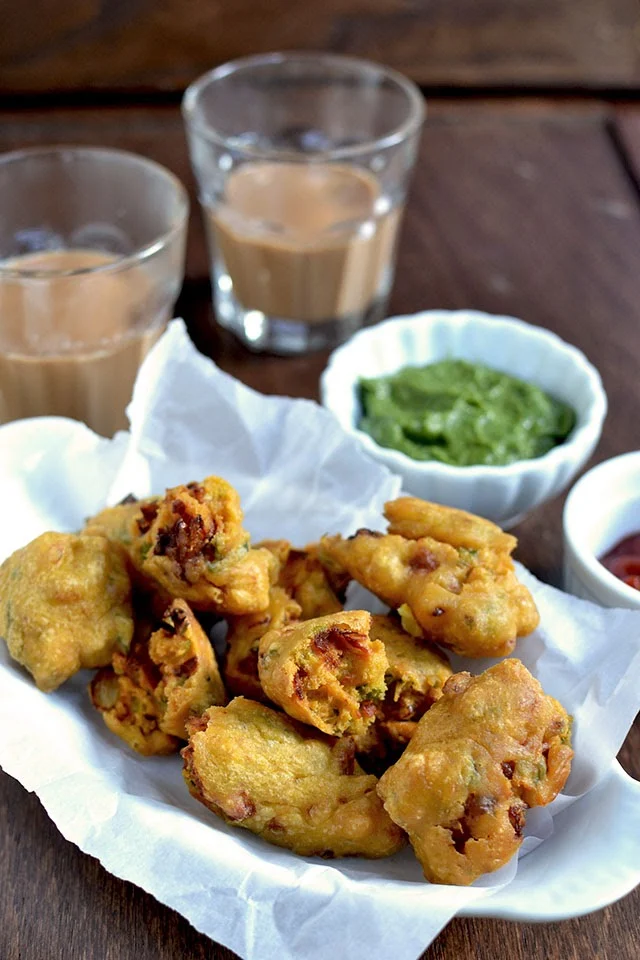
By the time the sun had climbed high enough to make the courtyard uncomfortable, the whole household had shifted into the kitchen, and this is where the day stopped feeling like a recipe and started feeling like a performance nobody had rehearsed but everybody somehow knew the steps to.
Rahul's Bua took over the dry mix and did something I had never once seen written down anywhere. She heated two tablespoons of the frying oil separately until it was faintly smoking, and instead of pouring it in at the end the way you would finish a tempering, she poured it straight into the dry besan and rice flour before a single drop of water had touched the mix, stirring it in immediately with a fork.
She called this waking the flour up, and it took me a while standing there to understand what she meant, that the hot oil creates tiny air pockets through the dry flour the instant it hits it, a kind of aeration that no amount of whisking with cold water can replicate, so that by the time the wet onions are folded in, the batter is already carrying air inside it rather than fighting to trap air later.
Only after that did the salted onions, along with every drop of liquid they had shed into their bowl, get folded into the flour. Amma insisted that this onion liquid was doing the binding work, and that anyone who reaches for the tap at this stage has usually skipped the salting step earlier and is now trying to fix a dry mix with the wrong kind of water.
The batter that resulted was nothing like the smooth, pourable batter I associate with pakora at home. It clung in thick, uneven clumps to the onion strands, closer to a coating than a batter at all.
Then came the part that made the whole kitchen laugh at me. Rather than stirring the mix with a spoon, Rahul's mother picked the bowl up slightly, tilted it, and began beating the batter against the inside wall of the bowl with the flat of her palm, again and again, for a good two or three minutes, the same motion I had seen used for kneading dough but faster and wetter.
She called this phentna, and said no halwai worth his salt trusts a fork for this, because the repeated slapping does the same job as a whisk would, working air bodily into the batter until it turns visibly lighter and slightly foamy at the edges, without needing a single pinch of any raising agent.
Before the first batch went anywhere near the hot kadhai, Rahul's father performed a small ritual that nobody in the kitchen treated as remotely unusual. He rolled a tiny piece of the batter into a rough ball, no bigger than a chickpea, and dropped it into the oil first, alone, watching it rise and colour.
Once it had cooked, he did not eat it and did not offer it to anyone. He fished it out and set it aside on the counter, uneaten, saying that the first pakora into a fresh cauldron of oil always carries away whatever ill luck or evil eye, the kadhai ki nazar, might be hovering over the kitchen that day, and that a halwai who skips this and eats the first piece himself is asking for the whole batch to stick or blacken.
I do not know what to make of this belief except that it has clearly outlived several generations of otherwise deeply practical cooks in that family, which tells you something about how seriously food and fortune are tied together in a Lucknow kitchen.
The frying itself happened in two distinct passes, and this, more than anything else that day, is the detail I now think about every single time I fry pakora at home. The first pass was gentle, oil kept at a moderate heat, and the onion clusters were dropped in loosely, flicked off the fingers rather than shaped into neat balls, so that thin, wild tendrils of onion stuck out in every direction, what Rahul's mother called the jali, the netting.
They came out pale gold, barely cooked, and instead of serving them, she lifted every single piece out onto a plate and let them rest there for a full three minutes, untouched, while steam visibly rose off them. Only after that rest did she raise the flame under the kadhai until the oil was properly hot again and dropped the same pieces back in for a final, fast minute, until they turned a much deeper gold and the sound they made when tapped against the side of the spoon was sharp rather than dull.
That two minute rest in between, she explained, lets the steam trapped inside each piece escape on its own terms, so that the second fry seals a genuinely dry, hardened crust rather than just browning a piece that is still damp in the middle, which is why a plate of these pakora could sit for two hours on the terrace that evening and never once turn soft.
The very last thing that happened before the plate reached the table was the fastest and easiest to miss. The moment the pakora came out of the oil for the last time, while the surface oil clinging to them was still visibly moving, Rahul's Bua tossed the whole batch in a small bowl of roasted cumin powder, amchur and coarsely crushed black pepper, working fast, because she said the spice needs the last of the pakora's own heat to toast properly against the crust.
Sprinkle the same mix over a cold pakora ten minutes later, she said, and all you get is raw powder sitting on top rather than flavour cooked into the surface.

The Sindhi Cousin's Double Cut
Somewhere in the middle of the afternoon, Rahul's cousin arrived with his wife, who had grown up in a Sindhi household, and she looked at our plate of pakora with polite disapproval before asking for a chopping board.
What she made next looked almost reckless to me. She took a handful of the half fried, pale batter clusters straight out of the first pass, before anyone had rested or refried them, laid them flat on the board, and sliced each one down the middle with a sharp knife, exposing the raw, barely set batter still glistening inside.
Those cut, open pieces went straight back into the hottest part of the oil, and where our own pakora had come out with a fairly even golden crust, hers came out looking almost violent, jagged at every cut edge, deeply browned in some places and nearly black at the sharpest points.
She said her own grandmother's kitchen used to make pakora exactly this way for wedding feasts, where hundreds of guests needed feeding quickly and a fritter that could be cut, refried and served within minutes was worth more than one that needed careful individual attention. Biting into one of hers, the difference was obvious immediately. Where ours shattered cleanly, hers crackled unevenly, throwing off small crisp shards with every bite, and there was noticeably more surface area for the oil and spice to cling to.
Evening, the Chutneys
As the light started turning that particular orange it only turns in Lucknow in early evening, the kitchen shifted its attention to the two bowls that would sit beside every plate that night. Rahul's mother made the green chutney first, coriander, mint, green chilli and a little raw garlic going into the mixer together, and she was very particular about the salt.
Not ordinary table salt, but a spoon of kala namak, the sulphurous black salt, which she said carries a faint mineral sharpness that mimics a kind of savoury depth you would otherwise only get from something like egg, and that this is what keeps the chutney from tasting flatly herbal. She was equally particular about the order of operations.
The greens, chillies and black salt went into the blender first, with only a splash of water, and were blended completely on their own. Only once the jar was stopped and opened did she squeeze fresh lemon juice directly into the ground paste by hand, stirring it in rather than blending it further.
Blending lemon at high speed along with the herbs, she said, especially if any pith or seed slips in, releases a bitterness that no amount of sugar can fix afterward, whereas folding the juice in afterward keeps the chutney tasting bright rather than sharp.
She also dropped a single ice cube into the jar before sealing it for storage, explaining that the friction of the blades heats the herbs just enough during grinding to start oxidising their chlorophyll, which is why so many homemade green chutneys turn a dull brown within an hour, and that the cold from the ice slows this down enough to keep the colour a proper, startling green well into the next day.
The second bowl was a saunth, dark, glossy and thick, made from amchur, jaggery and dry ginger, reduced slowly on the back burner while everything else was happening. Amma told me this exact chutney, cooked down long enough, could sit at room temperature for months without spoiling, and the reason had nothing to do with luck.
The amchur brings a natural acidity, the jaggery is reduced until the sugar concentration itself becomes inhospitable to anything trying to grow in it, and together they behave as their own preservative, provided you have the patience to reduce it properly rather than pulling it off the heat early.
I already had a version of this same chutney written down from an earlier visit to my own kitchen archive, and comparing the two side by side that evening only confirmed what Amma insisted on, that this saunth is not simply tamarind chutney under another name. Tamarind carries a deeper, almost smoky sourness, while amchur stays brighter and more fruit forward. The full method for that chutney, including exactly how long it keeps and how far to reduce it, is written out here, and it is, without any exaggeration, the same chutney that belonged on that plate.
Dal Pakode After Dark

Long after most of the guests had gone home and only the immediate family was left sitting around the kadhai, Amma was still not finished. A bowl of chana dal that had been soaking quietly since the afternoon came out, and she ground it coarse rather than smooth, leaving visible flecks of lentil rather than a fine paste, folding in the same ajwain and green chilli mix used earlier for the onions.
She called this the fritter a household makes for itself once the guests have left, using up dal that would otherwise sit in the fridge, and its texture stayed grainy and dense in a way that held its bite for far longer than the lighter onion pakora had. It felt, eaten at eleven at night on a terrace still faintly lit by leftover Holi lanterns, less like a snack and more like the family quietly closing the day out the same way they had opened it, standing around a hot kadhai together.
What the Terrace Remembered
It was on that terrace, well after the frying had stopped and everyone had a glass of something warm in their hands, that Rahul's father started talking about where any of this had actually come from, and it turned out he had read more about it than anyone else in the family.
He told me the word pakora itself reaches back to a Sanskrit compound, pakva for cooked and vata for a small rounded cake, and that further south and west the same idea took a completely different name, bhajiya, from bharjita, meaning roasted or fried, which is why a Marathi household and a Punjabi household are technically arguing about the exact same fritter under two different inherited words.
He mentioned a twelfth century Sanskrit encyclopedia, the Manasollasa, compiled under a Chalukya king, which already describes lentil flour dumplings fried in oil and seasoned with asafoetida and ginger, close enough to what Amma had made that afternoon that it startled me a little to hear it read aloud from his phone.
He also brought up an eleventh century Kannada text called the Lokopakara, written by a scholar named Chavundaraya, describing vegetables coated in a spiced legume batter and fried in ghee, which by his account makes this kitchen's basic method considerably older than any dynasty most people learn about in school.
He seemed almost proud, in a quiet way, to point out that centuries later, Portuguese traders sailing out of Goa carried this exact deep frying idea to Japan, where it eventually became tempura, meaning the technique now celebrated worldwide under a Japanese name had, by his account, first been perfected along the Indian coast.
He also had an explanation for why the whole family had been standing around a hot kadhai on a day when the courtyard had been cool and faintly wet since the overnight rain, something closer to a monsoon evening than a spring afternoon.
In Ayurveda, he said, this kind of damp, heavy air is meant to slow the body's own digestive fire, and food eaten during such weather is supposed to be met with something warming rather than something cooling, which is exactly what carom seeds, dry ginger and roasted gram flour are meant to do, stimulate rather than settle.
Whether the science behind that holds up or not, he said, is a separate question from why every household in this city still reaches for the same fritter the instant the air turns heavy, rain or no rain, season or no season.
Somewhere near midnight, with the last of the lanterns burning low, he mentioned one more thing almost as an afterthought, that the pairing of pakora with hot tea, which everybody now treats as though it has always existed, is actually a fairly recent habit in North India, no older than the early twentieth century, once tea plantations and their trade boards began actively pushing chai into Indian households that had never really taken to it before.
Long before that, he said, his own grandfather's generation would have reached for kanji, a fermented, mustard spiced black carrot drink, or a glass of spiced chaas, to go with exactly this kind of fried food, because both were believed to help settle the stomach after eating something fried, in a way tea never was.
Onion Pakora
Ingredients
| Red onions, thinly sliced lengthwise | 3 medium |
| Besan (gram flour) | 1 cup |
| Rice flour or fine poha powder | 3 tablespoons |
| Ajwain, crushed between the palms | 1 teaspoon |
| Whole coriander seeds, cracked | 1 teaspoon |
| Green chillies, finely chopped | 2 |
| Red chilli powder | 1 teaspoon |
| Turmeric powder | 1/2 teaspoon |
| Hing | A pinch |
| Coriander leaves, chopped | 2 tablespoons |
| Salt | To taste |
| Mustard oil, hot, for the dry mix | 2 tablespoons |
| Mustard oil, for deep frying | As needed |
| Roasted cumin powder, amchur, crushed black pepper | For dusting |
Method
- Salt the sliced onions on their own and let them stand for eight to ten minutes so they release their own moisture.
- Separately, mix besan, rice flour or poha powder, crushed ajwain, cracked coriander seeds, chilli powder, turmeric and hing.
- Heat two tablespoons of the frying oil until smoking and pour it directly into the dry mix, stirring at once.
- Fold in the rested onions along with all the liquid they have released. Add plain water only a teaspoon at a time if truly needed.
- Beat the mixture against the side of the bowl with an open palm for two to three minutes to work in air.
- Heat the frying oil until clear past its smoking point, then cool slightly to medium. Test with one small piece and discard it.
- Fry loosely flicked, open clusters at medium heat until pale gold, then rest for three minutes on a plate.
- Return to hot oil for a final minute at high heat until deep golden and audibly crisp.
- Toss immediately in the roasted cumin, amchur and black pepper while still hot, and serve at once with hari chutney and saunth chutney.