13 Easy Diwali Sweets and Snacks for Beginners
No sweet on this table is really about sugar. Each one is doing a job first, waking up a stomach before dawn, surviving a week in a cloth bundle, keeping a ledger clerk awake through the night, and I only understood that properly once I started making them one by one with those jobs in mind rather than just a taste in mind.
A genuinely beginner friendly Diwali sweet or snack does not depend on judging sugar syrup by eye and does not need khoya reduced from scratch over four hours. All thirteen here meet that bar, with full ingredients and method so you can actually cook from this page.
Chivda
the snack that has to be eaten before the sun comes up
It is four in the morning on Narak Chaturdashi and the sky outside is still pinned in black. The house carries that particular pre-dawn smell of warm sesame oil, sandalwood and wet earth from the Abhyanga Snan bath everyone has just finished, and lore holds that this bath washes away the same demon blood Krishna is said to have washed off after slaying Narakasura.
I stood shivering in fresh cotton clothes waiting for a steel katori of chivda to arrive, and the first bite, thin fried poha and golden peanuts and curry leaves broken cold between the fingers, was the quietest sound the whole festival makes all year. My own hands were the ones stirring that morning, and I remember pulling the pan off the flame a full minute too early the first time, watching the poha turn out chewy instead of glass crisp before I understood how much a low flame needs to be trusted rather than rushed.
The flattened rice for that very first Faral tray is traditionally roasted from that year's own freshly harvested autumn grain, not last season's stock, a detail no sealed packet on a shop shelf can ever promise you. Making it at home myself, tasting the citric tang wake up my own sluggish mouth at that hour, taught me the whole point faster than any explanation could, this is not a snack designed to be delicious first, it is designed to be a jolt.
How it was actually made in our house
In our home the chivda was never a same day job. Two days before Narak Chaturdashi, my grandmother would spread the poha out on a clean cotton cloth across the dining table to dry further, walking past it every hour to turn it by hand so it would not clump before it ever reached the pan.
My mother took over the evening before, roasting the peanuts and chana dal separately while my grandmother sat close by directing the flame from her chair, never quite trusting anyone else's timing even after decades of watching it done. By the time the actual dawn of Diwali arrived, all that was left was to bring the components together, which is precisely why the finished tin always tasted better than anything I managed alone in one sitting years later.
🌿 Ingredients
- 2 cups thin poha (flattened rice)
- 3 tablespoons oil
- 1/4 cup peanuts
- 2 tablespoons roasted chana dal
- 10 to 12 curry leaves
- 1 teaspoon mustard seeds
- 2 dried red chillies, broken
- 1/4 teaspoon turmeric
- 1 teaspoon sugar
- A pinch of citric acid or a squeeze of lemon
- Salt to taste
🔥 Method
- Dry roast the poha in a wide pan on low heat for 6 to 8 minutes, stirring often, until it turns crisp and slightly darker. Set aside.
- Heat oil in the same pan. Add mustard seeds, let them splutter, then add curry leaves and dried red chillies.
- Add peanuts and roasted chana dal, fry until the peanuts turn golden.
- Lower the heat, add turmeric, sugar, citric acid and salt, then add the roasted poha. Mix well for 2 minutes so everything is evenly coated.
- Cool completely before storing in an airtight tin.
Roasted Dal Namkeen
what kept a ledger room awake all night
Deep in the bazaar on Diwali night, a shop shutter sits half down while a single brass lamp still burns over red cloth bound ledgers. A grandfather dips his pen into crimson ink to write Shubha Labha at the top of a fresh page for Sharda Pujan, the youngest grandchild fighting sleep cross legged on a clean white gaddi beside him, a small copper bowl of dry roasted dal resting between them because it leaves no grease on those saffron stamped pages the way a fried sweet would.
I roasted my own batch with that exact image running through my head, and the part nobody had warned me about was how long the waiting actually feels, five, six, seven minutes of stirring with nothing visibly happening before the first real crackle finally arrives. I kept lifting one grain out with a spoon and biting it to check, again and again, until I finally trusted my own ears over my own impatience and let the second, deeper crackle tell me when to stop.
A finishing scatter of dried mint rather than only rock salt is what many of those same gaddi bowls actually held, and adding it myself at the end changed the whole character of the dal from merely salty to something closer to what I imagine kept those clerks genuinely alert past midnight.
How it was actually made in our house
My father soaked the dal himself two evenings before Diwali, always in the same steel bowl, then spread it on a thali to dry overnight under the ceiling fan rather than in the sun, a habit he said his own father had insisted on. My grandmother roasted the actual batch the following evening, sitting on a low stool beside the stove long after the rest of us had moved on to other Diwali chores.
She measured nothing by cup or spoon, only by the sound the dal made against the kadhai, and my father would fill the jar the next morning before it had even fully cooled, always the one who carried a handful with him on any journey that week.
🌿 Ingredients
- 1 cup chana dal or moong dal, soaked 30 minutes and dried on a cloth
- 1 teaspoon oil
- 1/2 teaspoon red chilli powder
- 1/4 teaspoon black salt
- 1/4 teaspoon chaat masala
- Salt to taste
🔥 Method
- Make sure the soaked dal is completely dry before it touches the pan, or it will not roast evenly.
- Heat the oil in a heavy pan on low flame. Add the dal and roast slowly, stirring constantly, for 12 to 15 minutes until deep golden and audibly crackling.
- Remove from heat, toss immediately with chilli powder, black salt, chaat masala and salt while still warm.
- Cool completely and store in an airtight container.
Sev
the savoury anchor that keeps sweetness from becoming too much
By late afternoon on Lakshmi Pujan the sitting room fills with an endless procession of guests, tea cups and overwhelmingly sweet silver foiled mithai, and I have watched a child slip away from that table looking genuinely weary of sugar. In old Marwari and Gujarati households this fatigue was taken seriously enough to have its own name, Kharap, and in some Gujarati kitchens this exact savoury is called Oma Podi rather than plain sev, offered specifically so a guest was never handed a sweet without something to cut it.
Pressing my own dough through a sev maker for the first time, I underestimated how much resistance a slightly too dry dough puts up against your own palm, my wrist ached before I had finished a single batch. Handing someone a fistful of that fresh, still warm sev straight from the oil cuts through the sugar fog in a way nothing shelf stable ever manages, because a bought packet is fried for months of shelf life first and flavour a distant second.
Serving a guest a sweet without a small handful of sev beside it was once read as a genuine breach of hospitality rather than simple forgetfulness, and once I understood that, I stopped thinking of sev as a garnish and started treating it as its own small act of care.
How it was actually made in our house
My mother pressed the sev on the afternoon before Lakshmi Pujan, always after the besan dough had rested exactly as long as she felt it needed, judged by pressing a thumb into it rather than a clock. My father held the press steady while she fed the dough in, a two person job in our house for as long as I can remember, neither of them ever trusting a single pair of hands to manage both the press and the hot oil at once.
The finished sev went straight into a tin that stayed on the kitchen counter rather than a shelf, specifically so it would be the first thing reached for once the sweet trays started arriving from neighbours the next day.
🌿 Ingredients
- 1 cup besan (gram flour)
- 2 tablespoons hot oil
- 1/4 teaspoon turmeric
- 1/4 teaspoon crushed clove, for Laung Sev
- 1/4 teaspoon black pepper powder
- A pinch of asafoetida
- Salt to taste
- Water as needed
- Oil for deep frying
🔥 Method
- Mix besan, turmeric, clove, pepper, asafoetida and salt. Add the hot oil and rub it into the flour.
- Add water gradually to form a soft but firm dough, firm enough to hold shape in the press without cracking.
- Heat oil for deep frying. Fill the sev press with dough and press directly into the hot oil in a circular motion.
- Fry on medium heat until light golden and crisp, turning once. Drain on paper.
- Cool completely and break into shorter pieces before storing.
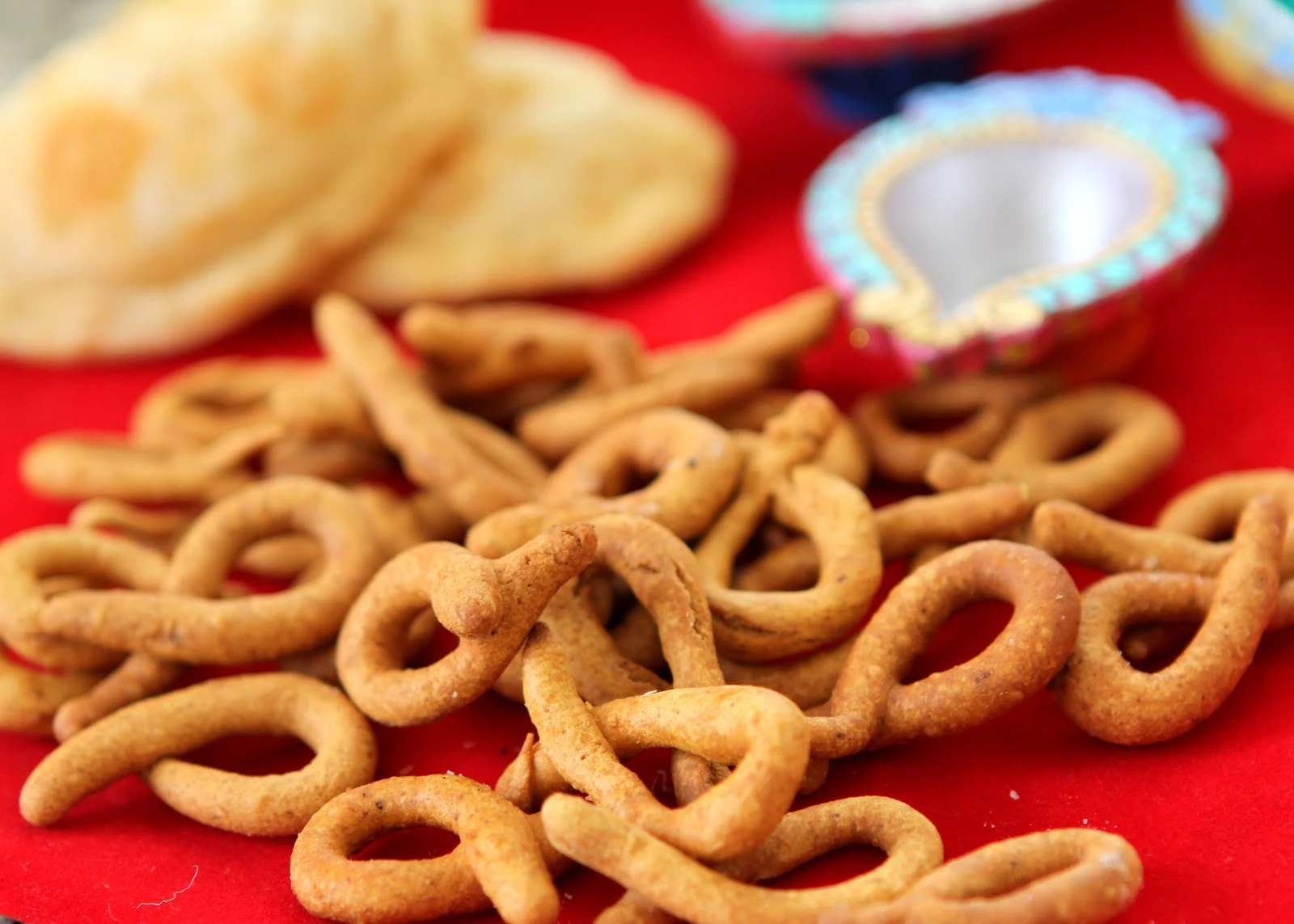
Ribbon Pakoda
the sizzle that once announced a demon's defeat
A week before Deepavali the kitchen floor disappears under clean newspaper, and a grandmother settles onto a low wooden stool with butter and rice dough slicked across both hands, lifting a heavy brass murukku achu with the same weight and ceremony every single year. Folk lore across Tamil Nadu and Andhra links the wavy ridges this press leaves behind to the torn armour straps of Narakasura himself, and frying it before sunrise on Naraka Chaturdashi, sometimes called Nada Thenkuzhal further south, was once heard almost as an announcement that the demon king had fallen, the sizzle itself standing in for the moment.
Children are given one job only, catching the golden ribbons once they cool and breaking them into pieces, and I found myself doing exactly that decades later in my own kitchen, flinching the first time a ribbon hit the oil closer to my hand than I meant to stand. A shop bought packet never carries that same first crackle, since it has usually gone cold and slightly stale before it ever reaches a shelf, and I only realised how much of the joy is in that very first sound once I had made a batch myself.
How it was actually made in our house
This was my aunt's task alone in our extended family, carried out on the evening two days before Deepavali, the brass press taken down from its cloth wrapping only once a year and cleaned by her own hands before anyone else was allowed near it. My cousins and I were given the job of catching the ribbons as they cooled, a role handed down from older cousins to younger ones over the years without anyone ever formally assigning it.
She fried in complete silence, concentrating on the oil rather than the conversation happening around her, and it was only once the last batch was out that she would finally sit down and join the rest of the family for tea.
🌿 Ingredients
- 1 cup besan
- 1/4 cup rice flour
- 2 tablespoons hot cold pressed sesame or groundnut oil
- 1/2 teaspoon red chilli powder
- A pinch of asafoetida
- 1 teaspoon sesame seeds
- Salt to taste
- Water as needed
- Oil for deep frying
🔥 Method
- Mix besan, rice flour, chilli powder, asafoetida, sesame seeds and salt. Add hot oil and rub in well.
- Add water gradually to make a soft dough, similar consistency to sev dough.
- Fit the ribbon disc into the press. Heat oil and press ribbons directly into it in small batches.
- Fry on medium heat until golden and crisp on both sides. Drain and cool completely before storing.

Soan Papdi
the box that quietly comes back home
It becomes a family joke every single year, the same immaculate box of saffron Soan Papdi passed from aunt to cousin to neighbour like an unspoken currency of goodwill nobody wants to open first. Then late on Diwali night, after the last cracker has whistled and the diyas have burned low, somebody finally peels back the foil at the family's own kitchen island, and it always tastes better once everyone stops pretending they did not want it all along.
In parts of Punjab and Western India the same sweet carries the older name Sohan Halwa, and what used to demand three or four master halwais pulling molten sugar and gram flour into threads thin enough to trap air, in royal pulling contests once held on Dhanteras night, is not something I could replicate alone in a home kitchen no matter how carefully I tried. I will say that plainly rather than pretend otherwise, my own attempt at the traditional pull collapsed into a sticky lump twice before I gave up and turned to the honest shortcut below.
Using ready sev strands bound in a light syrup gets close enough to that flaky dissolve on the tongue without needing several trained hands working together over a charcoal pit, which is the only reason this sweet belongs on a beginner list at all.
How it was actually made in our house
My uncle attempted the traditional pull exactly once, on a Dhanteras evening years ago, insisting he had seen it done as a boy at a family wedding, and it ended in a sticky, unsalvageable mess across our kitchen counter that my grandmother brought up every single year afterward. Since then our own box has always arrived from a shop rather than a home kitchen, the one sweet on our entire Diwali table nobody in the family ever tried to make again.
This year was the first time in our family's memory that anyone attempted a version at home at all, using the honest sev based shortcut rather than my uncle's doomed ambition, and it felt strange handing round something homemade that every relative still associates with a store bought foil box.
🌿 Ingredients
- 2 cups fine plain sev (unsalted, unspiced)
- 1 cup sugar
- 1/4 cup water
- 1/4 teaspoon cardamom powder
- 2 tablespoons chopped pistachios
🔥 Method
- Heat sugar and water together until it reaches a one string consistency, meaning a drop pulled between two fingers forms a single thin thread.
- Remove from heat, add cardamom powder, then quickly fold in the fine sev.
- Mix gently but quickly before the syrup hardens, then press into a flat tray.
- Sprinkle chopped pistachios on top, cool completely, then cut into squares.
Chikki
the pocket warmth handed over as winter arrives
Diwali lines up with Kartik Amavasya, the formal turning point into winter, and out on a chilly balcony under a sky full of thousand fold clay lamps I have watched an elder slip a piece of warm, brittle chikki straight into a child's coat pocket. Wrapped in crackling wax paper, the caramelised jaggery warms cold fingers before it ever reaches the mouth, at exactly the season rural communities once placed jaggery and peanut chikki at village boundary shrines as an offering against joint pain and the illnesses of the coming cold months.
Standing over my own pan waiting for the syrup to hit exactly the right point, I dropped my first bead into cold water too early and watched it dissolve into nothing rather than snap, which cost me nothing but a few extra minutes of patience the second time. Making it fresh myself at this exact point in the harvest, when sesame and cane jaggery are newly crushed rather than months old, gave the chikki a brighter, sharper jaggery flavour than any jar sitting on a shop shelf since the previous season.
How it was actually made in our house
My grandfather made a batch on our own balcony every single year, always on the evening the first real chill arrived rather than on a fixed date, judging the season by feel rather than the calendar. He kept the same chipped steel bowl of cold water beside the stove for the brittle test, a bowl my grandmother tried to replace twice over the years and which he quietly kept rescuing from the bin.
My job as a child was only to hold the greased tray steady while he poured, and I remember the syrup moving faster than I expected the very first time I was trusted with that small responsibility.
🌿 Ingredients
- 1 cup peanuts, roasted and roughly crushed
- 1 cup jaggery, grated
- 1 teaspoon ghee
🔥 Method
- Grease a flat plate or tray with ghee and keep ready.
- Melt the jaggery in a pan on low heat, stirring continuously, until it turns fully liquid.
- Test readiness by dropping a bead of melted jaggery into cold water. If it turns brittle instantly, it is ready.
- Add the crushed peanuts quickly, mix well, then pour onto the greased tray and flatten with a rolling pin.
- Cut into pieces while still warm, before it hardens completely.
Petha
the sweet built to survive a journey home
A Diwali special train pulls in three hours late, steam pouring into the crowded night air, and I have stood exactly where a father waits scanning the crowd for a daughter coming home from college, a moist box of Agra petha already in his cloth bag before the luggage is even off the train. Biting into that cool, translucent cube after a long dusty journey tastes like fresh water rather than a heavy sweet, and that lightness was precisely the design, legend holding that Shah Jahan wanted something that would not sour in unconditioned tents the way milk sweets do within hours.
By the late seventeenth century Mathura and Agra sweet makers were already sending cases of Angoori and Kesar Petha into Diwali bazaars marketed as the one sweet guaranteed not to spoil across a days long bullock cart journey. Pricking each cube by hand myself, over and over, before it ever touched the syrup, I understood exactly why that patience mattered, a cube pricked carelessly stayed cloudy and dense while a properly pricked one turned genuinely translucent by the second simmer.
Ash gourd cooked slowly in alum and soaked in syrup lasts weeks rather than days, which is exactly why a small homemade batch, refrigerated properly, kept its clean flavour far longer in my own kitchen than a roadside box that had already spent days in transit heat before reaching anyone's hand.
How it was actually made in our house
My mother kept a box of petha in our fridge every single Diwali because my father had grown up eating it as a child, though for years it was always bought rather than made at home, sliced thin by her for guests who had never tasted ash gourd cooked this particular way. It was only recently, over two full evenings before Diwali, that I first attempted making it myself in our own kitchen, pricking cube after cube by hand on the first evening and simmering the syrup slowly on the second.
My mother stood by the stove the whole time, not cooking, just watching and occasionally telling me to slow down, which turned out to be the single most useful piece of advice the entire process needed.
🌿 Ingredients
- 500 grams ash gourd (white pumpkin), peeled and cubed
- 2 cups sugar
- 2 cups water
- 1/4 teaspoon alum powder (phitkari), optional, for firmness
- 1/4 teaspoon dry ginger (saunth) powder
- A few strands of saffron
🔥 Method
- Prick the ash gourd cubes all over with a fork so the syrup can penetrate.
- If using alum, soak the cubes in water with a pinch of alum for 1 hour, then rinse well.
- Boil the cubes in plain water until slightly translucent and just tender, then drain.
- Make a sugar syrup with the 2 cups sugar and 2 cups water. Add saffron and dry ginger, then add the boiled cubes and simmer on low heat until fully translucent.
- Cool and store refrigerated.
Motichoor Ladoo
the grain of gold placed at a goddess's feet
Puja finishes, the brass bell falls silent, and the air turns thick with camphor and marigold as a towering mound of saffron scented motichoor ladoo sits at the altar beside Lakshmi and Ganesha's silver feet. In temple iconography Ganesha's trunk is often shown reaching directly toward a bowl of exactly this yellow sweet, and a grandmother breaks the first one into quarters, each tiny boondi pearl catching lamplight like a grain of unminted gold.
Pouring my own thin besan batter through a fine holed jhara for the first time, I watched half of it land as fat, uneven drops rather than pearls, because my hand was shaking slightly over the hot oil, and only steadying my wrist on the rim of the pan fixed it on the second try. Handed into an outstretched palm alongside a dab of vermilion, that soft, ghee soaked morsel felt closer to a spoken blessing than a dessert once I had stood over the pan myself and understood how much patience each pearl actually costs.
How it was actually made in our house
My grandmother owned the one jhara in our house, kept in a drawer nobody else was permitted to open, and the batter and syrup were always made across two separate evenings rather than one, the boondi fried the evening before Lakshmi Pujan and shaped into balls only the following morning once the syrup had properly settled overnight. My mother's job was always the syrup, stirred to exactly the consistency my grandmother approved of with a single glance rather than a taste test.
I used my grandmother's own jhara for the first time this year, standing at the same counter, and only then understood why she never once let anyone borrow it even for a single festival.
🌿 Ingredients
- 1 cup besan
- 3/4 cup water, approximately
- A pinch of baking soda
- A pinch of saffron
- Ghee and oil for frying, mixed
- 1 cup sugar
- 1/2 cup water for syrup
- 1/4 teaspoon cardamom powder
- Chopped pistachios for garnish
🔥 Method
- Mix besan, water, baking soda and a pinch of saffron into a smooth, lump free batter, slightly thinner than dosa batter.
- Heat ghee and oil together. Pour the batter through a fine holed jhara directly over the hot oil so tiny pearls (boondi) drop in and fry.
- Fry until just set but not browned, then drain.
- Make a sugar syrup with 1 cup sugar and 1/2 cup water until slightly sticky, add cardamom and saffron.
- Add the fried boondi to the warm syrup, let it soak for 10 minutes, then lightly crush with your hand for the dry, prasad style version rather than a wet one.
- Shape into balls while still warm, garnish with pistachios.
Pinni
a mother's parcel travelling hundreds of miles
In a cold university dorm or a rented city room, someone cuts open a taped parcel from Punjab just as the festive night begins, and inside sits a steel tin of dense pinni still bearing the deep press of a mother's four fingers from when the dough was hot enough to sting her own hands. Eating one with warm milk while fireworks flicker outside a lonely window carries an entire kitchen across a distance no phone call quite manages.
In Sikh tradition this same night is kept as Bandi Chhor Divas, marking Guru Hargobind Ji's return from imprisonment at Gwalior Fort, and pinni loaded with dried ginger and melon seeds was blessed at the Gurdwara before being handed out as stamina rations for long nights of guard duty. I roasted the whole wheat flour in my own pan far longer than felt necessary, well past the point where it smelled done to me, because that deep, almost nutty roast is what gives a labourer real sustained energy rather than a quick sugar spike.
Only once the jaggery went in while the flour was still warm did the whole mixture come together into something dense enough to actually press and hold shape, dense enough, I imagine, to actually survive a week long courier journey the way a soft bought sweet never would.
How it was actually made in our house
My own mother rolled a smaller batch of pinni at home every winter, starting the flour roasting two full evenings before Diwali since it could not be rushed on a single stove without burning, and finishing the shaping the next day once the jaggery had been folded in while everything was still warm. It was never as dense or as large as the tins that arrived from relatives in Punjab, but it was pressed with the same four fingers into the same rough, uneven discs.
I finally rolled my own batch this year standing exactly where she used to stand, and the shape came out crooked in precisely the way I remember hers being, which felt oddly correct rather than disappointing.
🌿 Ingredients
- 1 cup whole wheat flour, coarsely ground if possible
- 1/2 cup ghee
- 3/4 cup jaggery, grated
- 2 tablespoons chopped almonds
- 1 tablespoon edible gum (gond), fried and crushed
- 1/4 teaspoon cardamom powder
🔥 Method
- Heat ghee in a heavy pan, add the flour and roast on low heat, stirring continuously, for 15 to 20 minutes until deep golden and fragrant.
- Remove from heat, let it cool slightly, then mix in the grated jaggery while the flour is still warm so it melts into the mixture.
- Add almonds, fried gond and cardamom powder, mix well.
- While still warm enough to shape, press into round discs or balls.
- Cool completely before storing.
Nankhatai
the jar that slows the whole house down
Long after the loud celebrations wind down and marigold petals have been swept off the floor, Govardhan Puja afternoon brings a quieter kind of tea, and I have watched a family gather around a dining table simply to open an old glass jar of pale, cardamom scented nankhatai. Unlike anything fried earlier in the week, these crumbly rounds melt the moment they meet hot tea, releasing a buttery nutmeg perfume into a room where nobody is in any rush to leave the table.
That jar exists at all because of a seventeenth century bakery handover, a Parsi baker named Faramji Pestonji Dotivala inheriting an unsold Dutch bakery in Surat and reworking dried out, unsold European loaves into an eggless, ghee based biscuit that spread through Gujarati Hindu trading communities precisely because it stayed crisp through a humid coastal autumn. Creaming the ghee and sugar myself, I overworked the dough on my first attempt and ended up with biscuits that spread flat rather than holding a soft dome, a mistake I only fixed by handling the second batch far more gently than instinct suggested.
How it was actually made in our house
My father's mother baked these every single Govardhan Puja afternoon in our home, mixing the dough the evening before so it could rest overnight in a covered bowl on the kitchen counter, and refusing to use a thermometer, judging the oven purely by the smell drifting out after roughly ten minutes. My father was given the job of watching the tray only because he was the one member of the family who could sit still that long without opening the oven door out of impatience.
I still do not trust myself enough to skip checking mine early, even though her instinct, built over decades of the same afternoon repeated every year, never once failed her in front of me.
🌿 Ingredients
- 1 cup all purpose flour
- 1/4 cup besan
- 1/2 cup ghee, softened
- 3/4 cup powdered sugar
- 1/4 teaspoon baking powder
- A pinch of baking soda
- 1/4 teaspoon cardamom powder
- A few pistachio slivers for topping
🔥 Method
- Preheat oven to 170 degrees Celsius. Line a baking tray.
- Cream the ghee and powdered sugar together until light and fluffy.
- Sift in the flour, besan, baking powder, baking soda and cardamom powder. Fold gently into a soft dough without overworking it.
- Shape into small balls, flatten slightly, and press a pistachio sliver on top of each.
- Bake for 12 to 15 minutes until the base is light golden and the top has a fine crackle.
- Cool completely on the tray before storing in an airtight container.
Kachori
the smell that wakes a foggy morning courtyard
The morning after the big Diwali night arrives hazy with leftover smoke and dawn dew, and while the children are still asleep from a late night of fireworks, the kitchen is already alive with the sharp smell of frying asafoetida and crushed urad dal. Eaten hot on a damp veranda with tamarind chutney while birds pick at spent flower garlands, this is the ritual that resets everyone before festive visits resume.
Rajasthani and Marwari traders once timed exactly this kachori to Labh Pancham, the auspicious fifth day after Diwali when old accounts closed and departures for new trade routes began, the crust fried until moisture free enough and the filling heavy enough with hing to survive nearly a week of dusty travel without spoiling. My first three attempts at sealing the dough all split open the moment they touched the oil, filling spilling into the pan exactly the way every warning about this sweet promises, and it was only on the fourth try, pinching slower and flattening more gently, that one finally held its shape all the way through frying.
How it was actually made in our house
My mother fried these in our own kitchen every single morning after Diwali night, starting the dough and the urad dal filling separately the evening before so both could rest overnight, the smell of asafoetida frying reaching my room before I was ever properly awake. She never once needed to test the seal on a practice piece the way I still do on every batch I attempt, her thumbs simply knowing after enough years of the same motion.
My grandfather was always the first one at the table once they were ready, insisting on eating his standing at the kitchen counter rather than sitting down, a habit nobody in the family ever managed to talk him out of.
🌿 Ingredients
- 1 cup all purpose flour
- 2 tablespoons ghee, plus more for the dough
- Salt to taste
- Water as needed
- 1 cup urad dal, soaked and coarsely ground
- 1 teaspoon fennel seeds, crushed
- 1/2 teaspoon red chilli powder
- 1/2 teaspoon asafoetida
- 1/4 teaspoon garam masala
- Oil for deep frying
🔥 Method
- Rub ghee into the flour and salt until it resembles breadcrumbs, then add water gradually to make a stiff dough. Rest for 20 minutes.
- For the filling, heat a little oil, add fennel seeds and asafoetida, then the ground urad dal. Cook until dry and fragrant, add chilli powder, garam masala and salt, then cool completely.
- Divide the dough into small balls. Flatten each into a small cup shape, place a spoon of cooled filling in the centre.
- Gather the edges up and pinch firmly to seal completely, then flatten gently. Practise sealing on two or three test pieces before frying the full batch.
- Deep fry on low heat until fully dry and golden brown, turning occasionally. Drain on paper.
Bhel Puri
the rooftop feast the fireworks interrupt
High on a terrace on Diwali night, the sky turns into an exploding kaleidoscope of silver and green, and nobody wants to sit formally at a dining table and miss it. A large tub of homemade bhel gets carried up the narrow staircase instead, leftover faral, crushed papdi, sev, murmura and roasted peanuts tossed on the spot with tangy tamarind water.
Around Zaveri Bazaar and Girgaon in South Mumbai, merchant families once did the same thing at street level the moment their formal Lakshmi Pujan books were sealed for the night, breaking the quiet austerity of the prayer hall with exactly this kind of loud, communal street food. I mixed my own bowl too far ahead of serving once, out of impatience, and watched the puffed rice go soft and sad within the hour, which taught me faster than any instruction could that this dish genuinely only exists in the minute it is tossed together.
How it was actually made in our house
In our house the actual bhel was never prepared ahead, but every other evening leading up to Diwali quietly built toward it, since whatever papdi or sev survived the week's frying without being eaten straight from the tin ended up in that final bowl. My brother always insisted on tossing it himself once the night finally came, refusing anyone else's spoon anywhere near it, a habit he had clearly picked up from watching our father do exactly the same thing every year before him.
I let him do it again this Diwali, exactly as always, standing back the way our father used to, and the bhel somehow still tasted better for it than anything I could have mixed myself.
🌿 Ingredients
- 3 cups puffed rice (murmura)
- 1/2 cup fine sev
- 1/2 cup boiled and cubed potato
- 1/4 cup chopped onion
- 1/4 cup chopped tomato
- 2 tablespoons tamarind chutney
- 2 tablespoons green coriander chutney
- Chaat masala and salt to taste
- Chopped coriander leaves for garnish
🔥 Method
- In a large bowl, combine puffed rice, potato, onion and tomato.
- Add both chutneys and chaat masala, toss quickly and gently.
- Add sev on top, mix once more, and serve immediately so the puffed rice stays crisp.
- For a dry Sukha Bhel version, skip the wet chutneys and toss the puffed rice, sev and roasted peanuts with just chaat masala, salt and a squeeze of lemon.
Aloo Tikki
the corner stall lit by ghee and fairy lights
Formal prayers finished and silk sarees adjusted, the family takes to the old bazaar streets at eleven at night, pushing through a holiday crowd toward the corner halwai's giant iron tawa. Handed out on leaf bowls, scalding hot and topped with whisked dahi, ginger shreds and sweet sour saunth, each bite is a burst of warmth against the autumn chill.
This same night is also kept as Roop Chaudas in parts of Old Delhi and Lucknow, tied to sweeping out Alakshmi, poverty and squalor, and a tikki finished with raw ginger and dried pomegranate seeds called anardana was meant to stir the same digestive fire those small domestic bonfires were lit to protect. My own potatoes fell apart in the pan the first time because I had not let them cool fully, and only once I forced myself to wait, mash, and rest the mixture properly did the patty hold together the way a stall's does after decades of the same practice.
How it was actually made in our house
My father fried these on our own terrace every Choti Diwali evening, boiling and mashing the potatoes the morning before so they had the whole day to cool properly, something he was strict about long before I understood why it mattered. He used a battered iron tawa nobody else in the family was allowed to touch, insisting the crust needed real open air rather than a kitchen exhaust fan to char properly dark.
I finally understood what he meant the first time I tried frying my own indoors this year and got nowhere near that same depth of colour, no matter how long I left the patties on the flame.
🌿 Ingredients
- 4 medium potatoes, boiled, peeled and cooled completely
- 1/4 cup cooked and mashed chana dal, spiced lightly
- 2 tablespoons cornflour or bread crumbs
- 1/2 teaspoon amchur (dry mango powder)
- 1/4 teaspoon black salt
- 1/2 teaspoon roasted cumin powder
- 1 tablespoon chopped coriander leaves
- Salt to taste
- Oil for shallow frying
🔥 Method
- Mash the completely cooled potatoes. Using warm or undrained potatoes is the most common reason tikkis fall apart.
- Mix in cornflour, amchur, black salt, cumin powder, coriander leaves and salt.
- Flatten a portion of potato mixture, place a small spoon of spiced chana dal in the centre, and enclose it before shaping into a flat round patty about 2 centimetres thick.
- Heat oil in a flat pan. Shallow fry the patties on medium heat until golden and crisp on both sides, pressing gently with a spatula.
- Serve hot with chutney or yoghurt.
🪔 The rest of the Diwali tray
Needs precise batter and hot oil control. Not yet a dedicated recipe on this blog.
Relies on a multi day fermentation. Not yet a dedicated recipe on this blog.
🧧 Notes on storage and timing
| Item | Shelf life | Make ahead |
|---|---|---|
| Chivda | 2 to 3 weeks, airtight tin | Yes, anytime |
| Roasted Dal Namkeen | 3 to 4 weeks | Yes, anytime |
| Sev | 2 weeks | Yes, anytime |
| Ribbon Pakoda | 2 weeks | Yes, up to a week ahead |
| Soan Papdi | 1 to 2 weeks, sealed | Best fresh, within days |
| Chikki | 3 to 4 weeks | Yes, anytime |
| Petha | 1 to 2 weeks, refrigerated | 2 to 4 days ahead |
| Motichoor Ladoo | 4 to 5 days, refrigerated | 2 days ahead |
| Pinni | 2 to 3 weeks | Yes, anytime |
| Nankhatai | 2 to 3 weeks, airtight | Yes, anytime |
| Kachori | Up to a week, dry fried | Filling can be made 1 day ahead |
| Bhel Puri | Assemble fresh only | No, chutneys only |
| Aloo Tikki | Best fresh, few hours | Shape ahead, fry fresh |
A reasonable party shopping estimate for ten to twelve guests across a mixed sweet and snack table runs to roughly two hundred to two hundred fifty grams per person of combined sweets and snacks.
