20 Best Cherry Desserts to Try
There is something almost unfair about cherries. They arrive for a few weeks each year, vivid and briefly perfect, and then they are gone. This guide covers everything that happens in between — the tree blossom, the fruit, the science of why eating them matters, and twenty ways to use them before the season ends.
Cherry Tree Blossom: What It Is and Where to See It in 2026
The cherry tree blossoms before it fruits. That sequence matters to anyone planning a visit to a cherry-growing region because the blossom and the fruit are separated by roughly six to eight weeks, and confusing the two timings means either arriving too early and finding bare fruit trees, or too late and finding the blossoms already fallen.
Cherry blossoms have become globally associated with Japan, where the tradition of hanami — flower viewing — draws tens of millions of visitors each spring. In Japan, 2026 blossoms in central Honshu, including Tokyo and Kyoto, are expected around late March and peak in early April, lasting roughly one week at any given location before the petals begin to fall. The season moves gradually northward from Kyushu and Shikoku toward Hokkaido over the course of March to May.
What fewer people know is that cherry blossoms grow in considerable abundance across several Indian states, and the Indian blossom season offers something Japan rarely can: the flowers appear against dramatically different landscapes and in relative solitude.
Cherry blossoms in India: where to go and when
The wild Himalayan cherry, Prunus cerasoides, known locally in Himachal Pradesh as padmakh, produces white and pink blossoms that transform entire valley sides between March and April at mid-altitude, and from late April into May at higher elevations. Tirthan Valley in Himachal Pradesh, the districts of Kotkhai, Kumarsain, Mashobra and Narkanda near Shimla, and stretches around Dharamshala all produce blossom displays that rival the famous Japanese counterpart in visual impact, without the queues or the flight cost.
In northeastern India, the situation is different. Shillong in Meghalaya hosts what has become India's own dedicated cherry blossom festival, celebrating the blooms of a different species that flowers from November through to March rather than in spring. Manipur, Sikkim and Nagaland also have significant cherry blossom populations in this winter-spring window.
A particularly practical piece of knowledge: the full bloom of a cherry tree at any given altitude often lasts only three to five days before the petals fall. Checking with local accommodation or forestry contacts before travelling is the only reliable way to time it correctly, because weather patterns can shift the peak bloom date by one to two weeks in either direction from year to year.
From blossom to fruit: the cherry tree growing calendar
After pollination during the blossom period, cherry fruits take roughly eight to ten weeks to develop fully on the tree. In the Himalayan regions of Himachal Pradesh and Uttarakhand, this means cherry fruits appear in the markets from late May through July depending on altitude and variety. Lower orchards around Shimla produce fruit in late May and early June. Higher-altitude orchards near Kinnaur and Narkanda produce later, through June and into July.
The botanical name of the sweet cherry is Prunus avium, derived from the Latin word for bird, a reference to how efficiently birds spread cherry seeds across a landscape. The sour or tart cherry is Prunus cerasus. Both are stone fruits, meaning they contain a hard pit at their centre surrounded by edible flesh. The pit contains amygdalin, which is not toxic in the small quantities encountered when eating cherries normally, but which should not be ground up or consumed in quantity.
Sweet Cherry vs Tart Cherry: What the Difference Actually Means for You
There are more than a thousand cultivars of cherries worldwide, but they divide practically into two groups that behave very differently in both the kitchen and the body.
| Property | Sweet Cherry (Prunus avium) | Tart Cherry (Prunus cerasus) |
|---|---|---|
| Taste | Rich, sweet, low acid | Sharp, tangy, pronounced acid |
| Glycemic index | 22 (low) | Slightly higher but still low |
| Anthocyanin content | 60 to 297 mg per 100g depending on variety | Up to 558 mg per 100g in skins |
| Best use raw | Excellent, preferred for eating fresh | Too sharp for most people raw |
| Best use cooked | Good in cakes, clafoutis, jam | Excellent in pies, sauces, juice |
| Health research focus | General antioxidant, heart health | Gout, inflammation, sleep, muscle recovery |
| Popular varieties | Bing, Rainier, Lapins, Van | Montmorency (dominant in research) |
| Processing | Mostly sold fresh | Mostly sold as juice, powder, extract |
The most important practical implication of this difference for home cooks is that sweet cherries are almost always the right choice for raw eating and most dessert recipes, while tart cherries produce a noticeably more complex flavour in cooked preparations like pies, compotes and sauces. If you see a recipe calling for Morello cherries, it is asking for a tart variety.
The Health Benefits of Cherries: What the Science Actually Says in 2026
This section is not here to tell you that cherries are a superfood and leave it at that. The research is genuinely interesting, it has become more robust in the past three years, and it is specific enough to be practically useful.
Cherries and inflammation
The anthocyanins in cherries function as anti-inflammatory agents by blocking enzymes associated with inflammatory pathways in the body. Montmorency tart cherries contain the highest known concentrations of two specific anthocyanin types among all commonly consumed fruits. A review covering multiple clinical studies concluded that eating at least 45 cherries daily was associated with reduced markers of inflammation caused by free radical activity. This is roughly one standard serving of fresh cherries.
A 2025 meta-analysis examining ten clinical trials on tart cherries and athletic performance found that tart cherry juice consumption reduced inflammatory biomarkers and enhanced muscle strength by approximately 9 percent in participants. The authors concluded that tart cherry supplementation shows meaningful benefit for muscle function recovery after exercise-induced muscle damage.
Cherries and gout
Gout occurs when uric acid accumulates in the bloodstream and crystallises in joints, most commonly the big toe, causing intense pain. Among all dietary interventions studied for gout management, cherry consumption has the most consistent research backing. A 2023 randomised controlled study of 282 men with gout found that a tart cherry supplementary citrate mixture administered every four weeks produced meaningful reduction in gout attacks compared to the control group. Surveys indicate that as many as one in four gout sufferers already use cherries, cherry juice or cherry extract to manage their condition.
The mechanism is reasonably well understood. Anthocyanins and other polyphenols in cherries appear to lower serum urate levels and simultaneously reduce the joint inflammation that makes gout attacks so painful. A standard clinical recommendation seen in some research is half a pound of whole sweet cherries daily for gout management, though anyone with the condition should discuss dietary approaches with their physician.
Cherries and sleep
Cherries are one of the very few whole foods that contain meaningful levels of melatonin, the hormone that regulates the human sleep-wake cycle. They also contain tryptophan, an amino acid that the body uses to produce serotonin, which in turn is used to make melatonin. The combination creates a cascade that can genuinely improve sleep quality.
A two-week pilot study published in 2018 involving older adults with insomnia found that those who drank 240 millilitres of tart cherry juice in the morning and again two hours before bed gained an average of 84 additional minutes of sleep per night compared to their baseline. A 2023 systematic review and meta-analysis confirmed that tart cherry supplementation was associated with improved sleep quality metrics across multiple studies, though the authors noted that more dose-dependent research is needed.
The relevance of this for everyday cooking: if you want to include cherries for sleep purposes, tart cherry juice or a concentrated extract form is far more studied than fresh fruit consumption, though the trend of a warm tart cherry and magnesium drink before bed went viral in 2025 and appears to have a legitimate physiological basis.
Cherries, heart health and blood sugar
A 2025 pilot clinical study from Portugal, published in the International Journal of Molecular Sciences, tracked 27 healthy volunteers who consumed 280 grams of sweet cherries daily for 42 days. The intervention showed measurable improvements in oxidative stress markers and glycaemic regulation, alongside subjective reports of improved energy levels. The study was small and single-arm, meaning it needs replication at scale, but the findings support the longer-standing evidence from observational research linking regular fruit consumption, and cherry consumption specifically, to reduced cardiovascular risk markers.
Sweet cherries have a glycaemic index of only 22, which is lower than apricots, grapes, peaches, blueberries and plums. This makes them an unusually safe choice for people managing blood sugar levels, including those with type 2 diabetes, as a naturally sweet food that does not produce sharp glucose spikes.
Cherry nutrition at a glance
| Nutrient | Per Cup Raw Sweet Cherries (138g) |
|---|---|
| Calories | 87 kcal |
| Carbohydrates | 22 g |
| Fibre | 3 g |
| Natural sugar | 16 g |
| Protein | 1.5 g |
| Vitamin C | 10 mg (approx. 11% of daily value) |
| Potassium | 306 mg |
| Anthocyanins | 82 to 297 mg depending on variety |
| Melatonin | 0.013 to 0.017 mg per 100g (tart cherries) |
How to Choose and Store Cherries
The single biggest mistake people make with fresh cherries is buying them before they are ripe. A cherry does not continue to ripen once picked. If it is pale or firm when it comes off the tree, it will stay that way. At a market, look for cherries that are deeply coloured for their variety, plump, firm rather than soft or wrinkled, with green flexible stems rather than brown brittle ones. The stem should still be attached. A cherry without its stem deteriorates much faster.
Store unwashed cherries in the refrigerator in a breathable bag or container. Do not wash them until just before using, because water accelerates decay. Stored correctly, fresh cherries keep for five to seven days. For longer storage, pit and freeze them on a tray in a single layer, then transfer to a freezer bag once solid. Frozen cherries are perfectly usable in baked recipes, compotes, sauces and smoothies throughout the year.
Cherries in syrup, cherries in alcohol and cherry jam are the three traditional ways to preserve the summer glut for winter use. All three produce a product that keeps for twelve months or more when properly sealed.
The 20 Best Cherry Recipes: From Everyday to Impressive
The twenty recipes below are organised from simplest to most involved. They cover the full range of what cherries can do in a kitchen across sweet and preserved preparations.
1. Cherry Clafoutis
Classic Cherry Clafoutis
Clafoutis is a traditional French baked custard from the Limousin region, somewhere between a thick pancake and a flan in texture. The batter takes five minutes to make. The oven does the rest. This is the one recipe from this list that every home cook should make at least once when cherries are in season.
Serves 6. Prep time 15 minutes. Cook time 45 minutes.
- 500 g fresh sweet cherries, pitted
- 3 large eggs at room temperature
- 100 g caster sugar, plus 2 tablespoons extra
- 240 ml whole milk
- 80 ml double cream
- 60 g plain flour
- 1 teaspoon vanilla extract
- 0.5 teaspoon almond extract
- 1 pinch of salt
- 1 tablespoon unsalted butter for the dish
Heat your oven to 180 degrees Celsius. Butter a 25-centimetre round baking dish generously. Arrange the pitted cherries in a single even layer across the base. Whisk the eggs and 100 g of sugar together in a bowl until the mixture turns pale. Add the milk, cream, flour, vanilla extract, almond extract and salt. Whisk until completely smooth. Pour the batter over the cherries and scatter the remaining 2 tablespoons of sugar over the top. Bake for 40 to 45 minutes, until the edges are set and golden and the centre has a gentle wobble when you nudge the dish. Cool for 15 minutes before dusting with icing sugar and serving warm directly from the dish.
The centre wobble is intentional and correct. It will firm up as it cools. Do not overbake looking for a fully set centre or the texture will turn dry and rubbery. The using of both milk and cream in the batter produces a noticeably richer result than milk alone.
2. Cherry Jam
Weigh equal parts pitted cherries and sugar. Combine in a wide heavy-bottomed pan with the juice of one lemon per kilogram of fruit. Bring to a boil over high heat, stirring to dissolve the sugar. Continue at a rolling boil for 20 to 25 minutes, skimming foam as it forms. Test for set by placing a teaspoon of jam on a cold plate: if it wrinkles when pushed with a fingertip after a minute, it is ready. Pour into sterilised jars and seal immediately. Cherry jam keeps for twelve months in a cool dark cupboard.
3. Cherries in Alcohol
Fill a wide-mouthed jar with stemmed, washed cherries. Add 3 tablespoons of caster sugar and enough brandy, grappa or vodka to cover completely. Seal and store in a cool dark place for a minimum of four weeks before opening. The longer the infusion, the more intense the flavour. These cherries work as a topping for vanilla ice cream, as a filling for chocolate truffles, or simply eaten alongside strong cheese.
4. Cherry Cheesecake Without Baking
Press 200 g of crushed digestive biscuits mixed with 80 g of melted butter into the base of a 20-centimetre springform tin. Chill for 20 minutes. Beat 500 g of full-fat cream cheese with 80 g of icing sugar and 1 teaspoon of vanilla until smooth. Fold in 250 ml of lightly whipped double cream. Spread over the biscuit base and refrigerate for at least 4 hours or overnight. For the topping, simmer 300 g of pitted cherries with 50 g of sugar and 1 tablespoon of cornflour dissolved in 2 tablespoons of cold water until thickened and glossy. Cool completely before spooning over the set cheesecake.
5. Cherry Crumble
Toss 500 g of pitted cherries with 2 tablespoons of sugar and a squeeze of lemon in a baking dish. For the crumble topping, rub 100 g of cold cubed butter into 150 g of plain flour until the mixture resembles rough breadcrumbs. Stir in 80 g of caster sugar, 50 g of ground almonds and a pinch of cinnamon. Scatter evenly over the cherries. Bake at 190 degrees Celsius for 30 to 35 minutes until the topping is golden and the fruit is bubbling at the edges. Serve warm with vanilla ice cream or custard.
6. Cherry Tiramisu
Make a cherry syrup by simmering 200 g of pitted tart cherries with 80 g of sugar and 4 tablespoons of water for 8 minutes. Cool completely. Dip sponge fingers briefly in the syrup and layer them in a serving dish. Whisk together 500 g of mascarpone, 4 tablespoons of icing sugar and 1 teaspoon of vanilla until smooth. Spread half the mascarpone mixture over the first layer of sponge fingers. Add a layer of whole cherries. Repeat. Refrigerate for at least 4 hours. The cherry syrup replaces the coffee of the classic recipe and produces a lighter, more summery result.
7. Cherry Ice Cream
Blend 400 g of pitted fresh or frozen cherries with 120 g of icing sugar until smooth. Stir the puree into 300 ml of lightly whipped double cream and 200 ml of whole-milk yogurt. Transfer to a freezer-safe container and freeze, stirring well every 45 minutes for the first 3 hours to break up ice crystals. The yogurt keeps the texture scoopable without an ice cream maker. Serve within two weeks for the best flavour.
8. Cherry Compote
Combine 400 g of pitted cherries with 60 g of sugar, a strip of orange peel, 1 cinnamon stick and 3 tablespoons of water in a saucepan over medium heat. Cook for 12 to 15 minutes until the cherries have softened and the liquid has reduced to a syrup. Remove the cinnamon and orange peel. Use warm over porridge, pancakes, yogurt, cheesecake, vanilla panna cotta or vanilla ice cream. Keeps refrigerated for ten days.
9. Cherry Tart with Ricotta
Line a 23-centimetre tart tin with shortcrust pastry and blind bake at 180 degrees Celsius for 15 minutes with baking weights, then 5 minutes without, until pale golden. Cool completely. Beat 400 g of fresh ricotta with 60 g of icing sugar, 1 teaspoon of vanilla and the zest of one lemon. Spread the ricotta cream over the cooled tart case. Arrange 350 g of pitted sweet cherries over the top. Brush lightly with warm cherry jam thinned with a little water for a glossy finish. Refrigerate for 30 minutes before slicing.
10. Cherry Cake
Cream 180 g of soft unsalted butter with 180 g of caster sugar until pale and fluffy. Beat in 3 eggs one at a time. Fold in 200 g of self-raising flour sifted with a pinch of salt and 1 teaspoon of vanilla extract, alternating with 4 tablespoons of milk. Fold through 250 g of pitted cherries. Transfer to a buttered and lined 20-centimetre round tin. Scatter a small handful of extra cherries over the top and press them lightly into the batter. Bake at 175 degrees Celsius for 45 to 50 minutes until a skewer inserted in the centre comes out clean. Cool in the tin for 10 minutes before turning out.
11. Cherry Muffins
Whisk 2 eggs with 180 ml of whole milk, 100 g of melted butter and 1 teaspoon of vanilla. Separately combine 250 g of plain flour, 150 g of caster sugar, 2 teaspoons of baking powder and a pinch of salt. Add the wet ingredients to the dry and stir until just combined. Fold in 200 g of pitted cherries. Divide between 12 muffin cases. Bake at 190 degrees Celsius for 20 to 22 minutes until risen and golden. The muffins are done when a skewer comes out clean. Do not overmix the batter or the muffins will be tough.
12. Cherry Smoothie
Blend 200 g of frozen pitted cherries with 250 ml of almond or oat milk, 1 frozen banana, 1 tablespoon of honey and a pinch of cinnamon until completely smooth. For the tart cherry sleep version that went viral in 2025, blend 120 ml of pure tart cherry juice with 200 ml of oat milk, 1 tablespoon of honey and a pinch of sea salt over ice. Drink one to two hours before bed.
13. Cherry and Almond Strudel
Lay three sheets of filo pastry on a clean towel, brushing each with melted butter. Scatter 60 g of toasted breadcrumbs and 50 g of ground almonds across the surface, leaving a 4-centimetre border on one long side. Spread 400 g of pitted cherries mixed with 4 tablespoons of sugar along the near long edge. Roll firmly using the towel to assist, ending with the seam underneath. Brush the outside with butter and scatter with 1 tablespoon of caster sugar. Bake at 190 degrees Celsius for 30 to 35 minutes until deep golden. Dust with icing sugar and serve warm.
14. Cherry Semifreddo
Whisk 4 egg yolks with 100 g of caster sugar until pale and thick. Fold in 300 ml of whipped double cream and 200 g of pitted cherries pureed with 2 tablespoons of sugar. Pour into a loaf tin lined with cling film. Freeze for a minimum of 6 hours. To serve, turn out onto a platter, peel off the cling film and slice with a warm knife. Scatter fresh cherries and mint leaves over the top.
15. Cherry Pudding
Butter a 1-litre pudding basin and scatter 50 g of caster sugar over its surface. Fill with 400 g of pitted cherries. For the batter, cream 100 g of soft butter with 100 g of caster sugar. Beat in 2 eggs. Fold in 100 g of self-raising flour and 2 tablespoons of milk. Spoon over the cherries. Cover with foil and bake at 180 degrees Celsius for 35 minutes until a skewer comes out clean. Turn out immediately so the cherries settle on top with their juice running down through the sponge.
16. Cherry Focaccia
Make a basic yeast dough using 400 g of strong white bread flour, 7 g of fast-action yeast, 1 teaspoon of salt, 2 tablespoons of olive oil and 280 ml of warm water. Knead for 8 minutes, then let rise covered for 1 hour. Press into an oiled 30 by 20-centimetre baking tin. Press pitted cherries into the surface in a rough grid pattern. Drizzle generously with olive oil and scatter 2 tablespoons of demerara sugar and a few sprigs of fresh rosemary across the top. Rest for 20 minutes then bake at 200 degrees Celsius for 25 minutes until golden and cooked through. Sweet, savoury, substantial and unexpected.
17. Cherries in Syrup
Bring 300 ml of water, 200 g of sugar and the peel of one lemon to a boil until the sugar dissolves. Add 500 g of stemmed and washed whole cherries. Simmer for 5 minutes. Transfer immediately to sterilised jars, covering the cherries completely with hot syrup. Seal and invert for 1 minute to create a vacuum. These keep for twelve months in a cool pantry and are ready to serve over ice cream, yogurt or cheesecake at any time of year.
18. Cherry and Chocolate Cake
Melt 150 g of dark chocolate with 150 g of butter. Cool slightly. Whisk in 150 g of caster sugar, 3 eggs and 1 teaspoon of vanilla. Fold in 80 g of plain flour and a pinch of salt. Pour into a buttered and cocoa-dusted 20-centimetre tin. Press 200 g of pitted cherries into the top of the batter. Bake at 170 degrees Celsius for 30 to 32 minutes. The centre should be just set but still fudgy. Cool in the tin before cutting. The combination of bitter chocolate and fresh cherry is one of the most reliable flavour pairings in dessert cookery.
19. Drunken Cherries
Wash and dry 500 g of cherries without removing the stems. Pack into a sterilised wide-mouthed jar with 4 tablespoons of caster sugar. Pour over enough brandy or rum to cover the cherries completely. Seal tightly and store in a cool dark place for a minimum of four weeks, ideally three months. Turn the jar gently every week during the first month to dissolve the sugar. The longer they infuse, the more complex the result. A jar made in early June is ready in time for the holiday season.
20. Dark Chocolate Cherry Truffles

Chocolate truffles made with whole cherries at their centre. The ganache is rolled in cocoa powder for the classic finish, though tempered dark chocolate also works beautifully.
Dark Chocolate Cherry Truffles
These are the most impressive item on this list relative to the effort involved. The ganache wraps around a whole cherry, which means cutting into a truffle reveals a complete fruit inside. They are the kind of confection that looks as though it came from a patisserie and takes thirty minutes of active work.
Makes 20 truffles. Prep time 20 minutes. Setting time 1 to 2 hours.
- 20 fresh cherries with stems where possible
- 200 g good-quality dark chocolate with at least 70 percent cocoa
- 80 ml double cream
- 20 g unsalted butter
- 2 tablespoons of good cocoa powder for rolling
Pat the cherries completely dry with kitchen paper. If the cherries were soaked in alcohol beforehand, let them drain on a wire rack for 30 minutes and then pat dry. Break the chocolate into a heatproof bowl. Heat the cream to just below simmering and pour it over the chocolate. Leave for 2 minutes, then stir from the centre outward until smooth and glossy. Add the butter and stir until incorporated. This is the ganache. Refrigerate the ganache for approximately 45 minutes to 1 hour until it is firm enough to hold a shape when scooped but still pliable. Working quickly with cool hands, take a heaped teaspoon of ganache and flatten it in your palm. Place a cherry in the centre and fold the ganache up and around it, smoothing the join. Roll gently between your palms and then roll in cocoa powder to coat completely. Place on a tray lined with baking paper and refrigerate until serving. They keep refrigerated for up to five days.
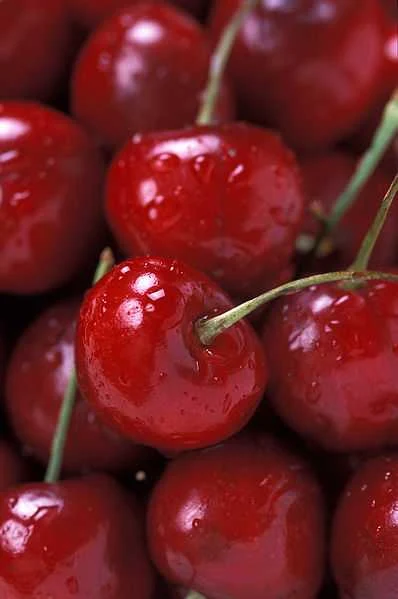
Sweet ripe cherries photographed at peak ripeness. The deeper the colour, the higher the anthocyanin content and the more pronounced the health benefits.
Frequently Asked Questions About Cherry Fruit
When is cherry season in India?
Cherry fruits ripen in the Himalayan regions of Himachal Pradesh and Uttarakhand from late May through July depending on altitude. Lower orchards around Shimla and Dharamshala produce fruit from late May. Higher areas in Kinnaur produce into July. The cherry tree blossom season in these areas is earlier, from late March through April.
What is the difference between sweet cherries and tart cherries?
Sweet cherries, Prunus avium, have a low glycaemic index of 22 and are ideal for fresh eating and most dessert recipes. Tart cherries, Prunus cerasus, have significantly higher concentrations of anthocyanins and polyphenols and are the subject of most health research into gout, inflammation, muscle recovery and sleep improvement. Montmorency is the dominant tart cherry variety studied in research.
Do cherries actually help with sleep?
Yes, the evidence is reasonable. Cherries contain melatonin, tryptophan and serotonin. A 2018 two-week study found that tart cherry juice drinkers gained an average of 84 additional minutes of sleep per night. A 2023 meta-analysis supported the association. Tart cherry products in concentrated form produce stronger effects than fresh sweet cherries for this purpose.
Can cherries help with gout?
Research suggests yes. Anthocyanins in cherries reduce uric acid levels and joint inflammation. A 2023 randomised study of 282 men with gout showed meaningful reduction in attacks with a tart cherry supplementary mixture. A typical dietary recommendation in research is around 45 cherries or a serving of concentrated tart cherry juice daily. Always discuss with your doctor alongside any prescribed gout medication.
How do I know when cherries are ripe enough to use?
Look for deep, uniform colour for the variety. The fruit should give slightly when pressed near the stem without being soft or wrinkled. The stem should be green and flexible rather than brown and brittle. A ripe cherry has a faint sweet fragrance at the stem end. Cherries do not continue ripening after picking, so avoid buying pale or hard fruit hoping it will improve at home.
What can I make with cherries when they are in season?
The list on this page covers twenty options, including clafoutis, cheesecake, jam, ice cream, tiramisu, crumble, tart, cake, muffins, smoothies, chocolate truffles, compote, focaccia, semifreddo, pudding and strudel. Of these, the three with the longest shelf life are cherry jam (twelve months), cherries in syrup (twelve months) and drunken cherries in alcohol (twelve months or more).
Where can I see cherry blossoms in India without going to Japan?
Shillong in Meghalaya has a dedicated cherry blossom festival from November to March. In Himachal Pradesh, Mashobra, Narkanda, Dharamshala and Tirthan Valley bloom from late March to April. Sikkim, Manipur and Nagaland also have significant blossom displays. The blooms last only three to five days at any given altitude, so timing requires checking local conditions close to your travel date.

Kalyan Panja
Kalyan Panja is a photographer and a travel writer sharing stories and experiences through photographs and words since 20 years
The truffles and the bars look luscious. Great recipes and photos!
Chocolate já é muito bom... com cerejas... receitas deliciosas.
Boa semana!
Beijinhos.
Brasil
✿⊱╮
¸.•°`♥✿⊱╮
Ahh, these lovely pictures of the cherries are making me miss summer so much! Very nice pictures and recipes. Thanks for posting them. Your posts always contain useful information. :)