Leonid Afremov: The Palette Knife Painter Who Conquered eBay
Before algorithms and art fairs decided who gets seen, a father in Ashdod painted through the night and his teenage son knocked on strangers' doors carrying wet canvases. That gamble built one of the most recognized names in internet art history.
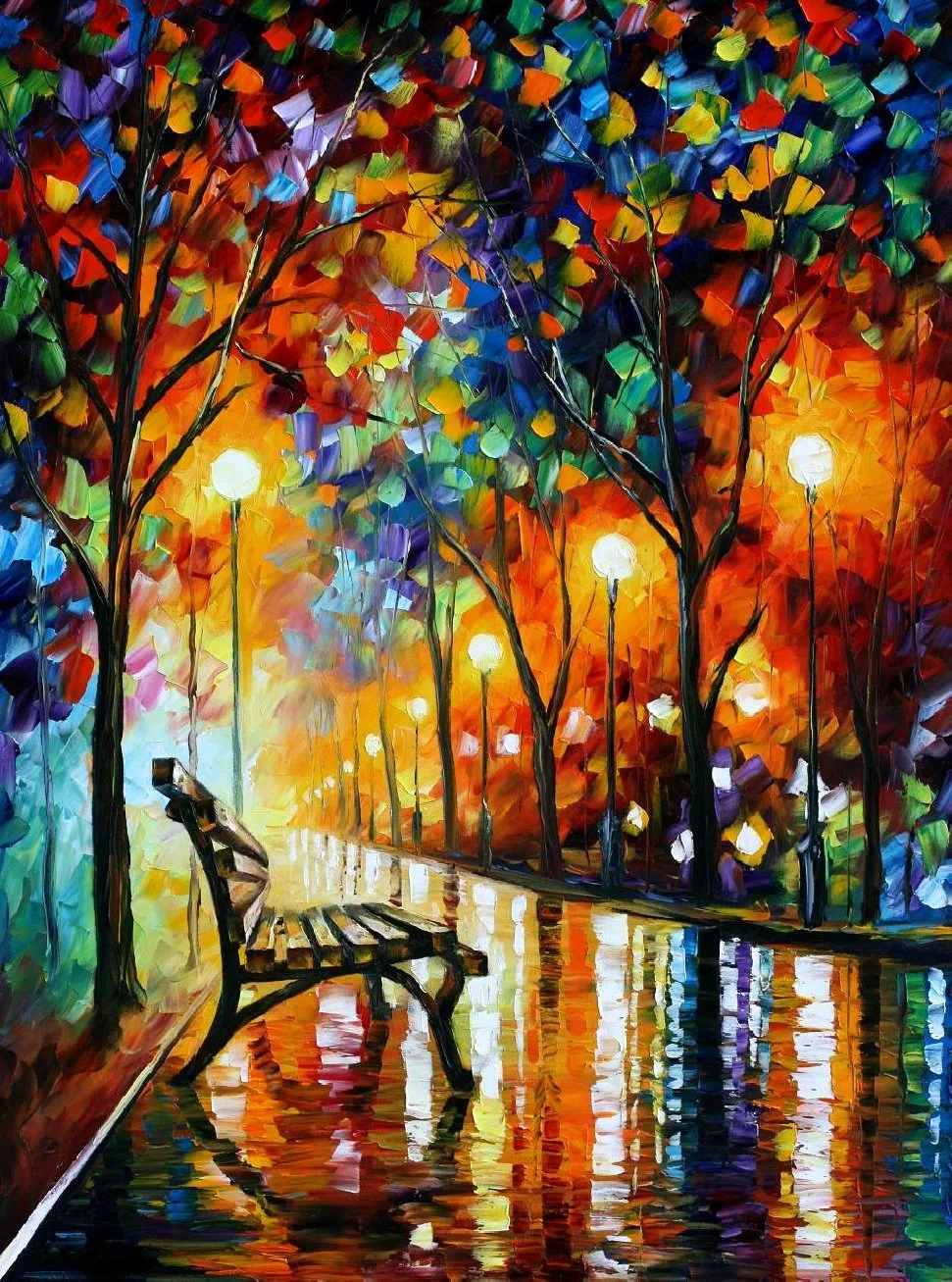
The blazing oranges, the wet black streets, the couples under one umbrella walking into a Paris that never quite existed, these images define Afremov's public identity. The stranger and more human part of his story sits underneath that color, in eBay seller pages from two decades ago and interviews his sons gave to small trade publications. A Jewish shoemaker's son from Belarus was blocked from every official art union in his own country, arrived in Israel with almost nothing, and had his art career rescued twice, first by a sixteen year old boy carrying paintings in bags from apartment to apartment, and again a decade later by a computer literate younger brother who had just discovered eBay.
Afremov did not become known through a gallery discovering him. Galleries in three countries turned him away over three decades, and his family built a sales route around each rejection in turn. That sequence of workarounds shaped his career at least as much as the palette knife technique did.
Afremov's paintings are frequently listed as watercolor or acrylic in his early Israeli years, not oil. He committed fully to oil paint and the palette knife once his sons found buyers willing to pay for original expression rather than safe, repeatable subjects.
1Vitebsk, Chagall, and a childhood spent painting in secret
Leonid Afremov was born on 12 July 1955 in Vitebsk, in what was then the Byelorussian Soviet Socialist Republic. His father Arkadiy was a shoemaker and shoe designer, his mother Bella worked in a metal factory, and both were determined that their son would be raised inside Jewish tradition despite the risks that carried under Soviet rule. Yiddish was spoken quietly at home even though it could invite official suspicion.
Afremov was born in the same town as Marc Chagall, who later became a significant role model to him. He trained at the Vitebsk Art School, an institution with roots tracing back to Chagall himself, and studied alongside the long shadow of the Vitebsk avant garde movement that once included Chagall, Kazimir Malevich, and Wassily Kandinsky. It is one of the more remarkable and underreported coincidences in modern art history that a boy who would grow up to be blocked from Soviet artistic institutions for being Jewish was educated in the very school founded by the most famous Jewish painter to come out of that same city.
His early professional life was ordinary rather than artistic in any recognized sense. After graduating, Afremov worked designing labels for a local beer and liquor factory and briefly as a set decorator in a municipal theater. In the early 1980s he built seasonal, government sanctioned propaganda displays for schools and collective farms, including plaster busts of Soviet leaders. This was steady work, and it kept his family fed, but because of his Jewish background he was never permitted membership in the official artists' unions that controlled exhibitions and legitimate sales inside the USSR. His own paintings during this period were sold privately, through friends and neighbors, off the books entirely, and many of them were never catalogued and are now lost.
He had a very good reputation designing propaganda walls for communal farms, yet the same government that hired him for that work would not let him show a single personal painting in a state gallery.
The turning point that pushed the family out of Belarus was not purely political. In 1986 the Chernobyl disaster occurred only a few hundred kilometers away, and fallout reached Vitebsk through wind and rain. Afremov's young son was among the children affected by the contamination. Combined with the ongoing discrimination the family faced, this pushed Leonid to take advantage of the brief window opened by Mikhail Gorbachev's reforms, which allowed Soviet Jews to emigrate. In May 1990 the Afremov family landed at Ben Gurion Airport and began a new, and initially much harder, chapter.
Afremov managed hypertension for much of his adult life, a health issue that shaped his stamina during the demanding door to door and gallery years that followed.
2The Israel years: rejection, a vandalized gallery, and a teenager selling art house to house
This part of Afremov's story reads closer to an immigrant survival account than a conventional art biography. Israel in the early 1990s was absorbing an enormous wave of Russian speaking immigrants from the collapsing Soviet Union, and the social friction that came with that wave shaped much of what happened to the Afremov family next.
Walking through the dense working class neighborhoods where many Soviet immigrant families settled, the air smelled of hot dusty limestone baked by the Mediterranean sun, mixed with the damp scent of laundry hanging from crowded concrete balconies. The acoustic soundtrack of that era was the sharp echo of footsteps climbing bare concrete apartment stairwells, carrying unframed canvases tucked under an arm, knocking on heavy wooden doors, and hoping a neighbor would trade cash for a piece of art. Inside the workspace, the sharp pungent chemical smell of fresh oil paint and turpentine cut through the cramped apartment, serving as a stark escape from the external stresses of trying to break into a local art scene that often shut immigrant artists out.
A few weeks after arriving, Afremov found work as a sign designer in a local advertising agency, and afterward made picture frames in a gallery shop, which is where he first began experimenting with the palette knife as a painting tool rather than just a frame maker's implement. But selling his own art proved brutally difficult. Because he was a recent Russian immigrant, local galleries were unwilling to give him fair prices, and he was largely restricted to producing whatever narrow, familiar subjects the market would tolerate, mostly in acrylic and watercolor rather than the oils he preferred.
The family moved to Ashdod, a coastal city with a large Russian immigrant population, hoping to find a friendlier audience. It did not fully work. Israeli media largely ignored his exhibitions, and according to family accounts his early gallery space in Ashdod was vandalized more than once, with equipment stolen and paintings damaged. That repeated setback is the direct reason the family turned to unconventional sales channels, a decision made out of necessity rather than strategy.
Out of what family members later described as extreme desperation, Afremov's sixteen year old son Dmitry began carrying his father's paintings door to door through neighborhoods heavily populated by newly arrived Russian immigrants in 1994. His older brother had already been helping with street fairs and club exhibitions, but door to door sales in Israel at that time were unexpectedly effective, since many recent immigrants moving into new homes needed inexpensive decoration and responded to a familiar face selling familiar themes. Boris, the youngest son, has since described helping prepare the canvas bundles at home before his brother and father set out each evening, a domestic detail that is largely absent from formal biographies of the artist.
The strategy worked well enough that by 1995 the family had saved enough to open a proper gallery and frame shop in Ashdod. It remained a struggle. The shop mainly attracted fellow Russian speakers rather than the broader Israeli public, and vandalism struck again in 2001, ultimately convincing Afremov it was time to leave the country entirely.
3New York rejection, Florida, and the eBay auction that changed everything
In late 2001, Afremov shipped roughly a hundred of his best paintings to his sister in Brooklyn and traveled to New York with his son to try American galleries directly. The terms offered were poor, mostly fifty fifty consignment deals with no upfront payment, or flat buyout prices as low as one hundred to two hundred dollars per canvas. The brutal New York winter aggravated his arthritis, so in early 2002 the family relocated to Florida, first briefly to the New York area then on to Fort Lauderdale and eventually Boca Raton.
Florida galleries were only marginally kinder, still limiting him to a narrow set of subjects they knew would sell. The real shift happened almost by accident. In 2003 a school friend of Boris bought a guitar on eBay, and Boris became fascinated by the platform, quickly setting up an eBay seller account under the name vitebskfineart for his father the following year. Boris was the family's most computer literate member, and once the first paintings were listed, results came almost immediately, with pieces selling for hundreds and sometimes thousands of dollars, every listing selling without exception.
In 2005, following a strong sales year, the family moved to Boca Raton and took their first family vacation to Cancun and Playa del Carmen, a trip that would eventually pull Afremov to relocate permanently to Mexico. Playa del Carmen later became his final home, but it began as an ordinary family holiday made possible by eBay income.
This was the moment Afremov finally began painting what he wanted rather than what galleries dictated. Freed from consignment deals and gallery gatekeeping, he leaned fully into the palette knife and oil, producing the rain soaked cityscapes, jazz musician portraits, and glowing autumn parks that define his visual identity today. In 2007, with his sons' help, he launched his own website to sell directly, and by 2009, after undergoing heart bypass surgery, he stepped back from day to day business while Dmitry and Boris took over sales, customer service, and shipping.
He died on 19 August 2019 in Playa del Carmen, Quintana Roo, Mexico, survived by his wife, two sons, and four grandchildren.
4What actually happens when a painter abandons the brush
The palette knife is, by design, a tool meant for scraping old paint off a canvas, not applying new paint to one. Almost no working painter uses it as their sole instrument, because it removes the fine control a brush allows and forces the artist to build an image from blunt planes and ridges of color rather than delicate lines.
Afremov reportedly spent roughly a decade refining the technique before it reached the fluency seen in his mature work. Reports from people who watched him paint describe a process where thick oil is loaded directly onto the blade and then dragged, pressed, or dabbed onto the canvas in short confident strokes, building up an impasto surface with real physical texture you can feel with a fingertip. Because each mark carries its own thickness and direction, the paintings catch light differently depending on the angle you view them from, which is part of why photographs of his work never fully capture the in person effect collectors describe.
The smallest blades used in his kit were reportedly only about an inch and a half long, small enough to carve individual leaves and raindrops out of thick wet paint.
The comparison to impressionist masters he is often grouped with holds up only partially. Van Gogh used heavy impasto too, but mostly with a brush, building texture through repeated layered strokes. Monet's late water lily canvases achieve their shimmer through broken color and rapid brushwork rather than raised paint. Afremov's closer technical cousin is Chaim Soutine, another Vitebsk trained Jewish painter who worked thick expressive paint with real aggression. Serious critics have generally kept Afremov outside the fine art canon and closer to the commercial and decorative art category. What he does share with these earlier painters is the same impasto family of tools, applied toward a different, more commercially oriented end.
5The Chagall connection
The Chagall link sits at the center of how Afremov's biography gets told, and it holds up under scrutiny in a way many artist origin stories do not. Both men were born in Vitebsk to Jewish families, both faced antisemitism that shaped their early careers, and Afremov trained at a school tracing its lineage directly back to Chagall's own founding role in the Vitebsk art scene of 1918 to 1921. Walk through the old quarter of Vitebsk today and a local guide will still point out the same crooked lanes and low rooftops both painters would have known as boys, decades apart, under very different flags.
Where the connection thins out is on the canvas itself. Chagall painted dreamlike, symbolic scenes full of floating figures, folklore, and personal mythology rooted in Hasidic culture. Afremov's mature work is almost entirely representational, built around light, weather, and mood rather than symbolism or narrative. What the two men share is a birthplace and a shared experience of exclusion, not a shared visual language. The Chagall connection is a story about a city and an inherited identity, not a claim that one painter picked up where the other left off.
6Why hospitals and therapists started using his paintings
Afremov's paintings gained a reputation among some psychologists and psychiatrists as visually calming and relaxing, and were reportedly used in various psychological and psychiatric therapy settings, appearing not only in art magazines but also in health and medical publications as examples of stress reducing imagery. Waiting rooms, small clinics, and quiet corners of family homes picked up on the same instinct long before any of that made it into print. There is something about a wet lamplit street rendered in warm orange that seems to lower the temperature of a room rather than raise it, and that reputation spread the way most useful folk knowledge does, one recommendation at a time rather than through a single study.

7Originals, recreations, and the counterfeit problem
Every serious collector of Afremov eventually runs into the same uncomfortable arithmetic. For roughly two decades, Afremov's family has fought an ongoing battle against counterfeiting, with Dmitry Afremov stating publicly that forgeries of his father's work were already circulating out of China even in the earliest years of the online business. In a public response to a buyer complaint, the family itself acknowledged that Afremov is likely the most counterfeited artist of the past fifteen years, estimating that a very large majority of paintings sold online under his name are not original works by his hand, and stating that the studio removes large numbers of fake listings from marketplaces on an ongoing basis.
Almost anyone who has ever tried to resell an Afremov painting runs into the same wall. The family's certificate of authenticity names the original purchaser, which means a second owner can rarely prove clean provenance on paper alone.
Leonid Afremov died in 2019, yet the business built around his name kept selling long after, which is exactly where the confusion for new buyers usually starts. Any painting dated after August 2019 was not painted by him personally, no matter what a listing implies. The family's own studio has continued producing hand painted recreations since his death, made by artists who trained alongside him for years, and it labels these honestly as recreations or studio pieces priced well below true originals. The trouble almost always begins at third party resale points, particularly overseas marketplaces and unofficial listings, where a recreation quietly loses its label somewhere between the studio and the buyer's wall.
Listings described as coming from an Afremov Home Collection add another layer worth knowing before you buy. The phrase refers to paintings the family says were kept from their own private stock rather than sold through the standard catalog, though the claim itself carries no outside verification. Treat it the way you would treat any other authenticity claim, and ask for it in writing.
If you are buying, the rule that protects you is simple. Ask directly whether a piece is an original painted personally by Leonid Afremov before his 2019 death or a studio recreation, request documentation beyond a bare certificate, and treat an unusually low price on a supposedly original oil as a warning rather than a bargain.
8Democratizing art ownership, and what happened to resale value
Afremov's real legacy in art history may end up being less about his paintings and more about the distribution model his sons built almost by accident. Before the internet, an artist without gallery representation had very few paths to a paying audience. Afremov's family proved that a self representing artist could build a sustainable, international collector base entirely outside the traditional gallery and auction house system, using door to door sales, then eBay, then a direct to consumer website, in that order.
For collectors, this creates an unusual resale market. Verified original oils painted personally by Afremov before 2019, especially larger canvases with documented provenance, have held or increased in value at auction and specialist gallery resale. Studio recreations and open edition prints, by contrast, depreciate the way most decorative reproductions do, since they can be produced indefinitely. The gap between those two categories is wide enough that provenance research is not optional if resale value matters to a buyer.

Afremov's story extends beyond the paintings themselves. A talented person shut out by institutional gatekeepers found a direct channel to an audience, first physical and then digital, that eventually let the work reach buyers on its own terms. A teenager knocking on doors in Ashdod in 1994 and a younger brother opening an eBay account a decade later were running an early version of the direct to consumer model that now defines how many independent creators build an audience.
