New Market: The Ultimate Guide to Kolkata's Shopping Paradise
Before the malls, before the metro, there was a garden with a fountain outside a red brick arcade, and a Baghdadi Jewish baker who once fought with a customer over Humpty Dumpty's missing half.
My grandmother never said New Market. She said Hogg Shaheber Bajar, with a small pause before Hogg, the way people say a word borrowed from someone they never quite trusted. She went once a year before Christmas, for one thing only, a fruitcake from a shop she called Nahoumer dokan rather than by its actual name. My chhoto mama, her younger son, tells it differently whenever the subject comes up. In his version she also went in October for Bandel cheese, wrapped in wet cloth so it would survive the tram ride home, and he still remembers the smell filling the compartment and an elderly co passenger complaining loudly about it the whole way.
My baba has his own version, which has nothing to do with cheese or cakes. He remembers going with his own father sometime in the late 1970s to get a suit stitched at one of the old tailoring shops near the front lanes, standing still for what felt like an hour while a tailor measured him with a tape that had gone soft and grey from decades of handling. He still complains about that hour whenever New Market comes up at the dinner table, half joking, half not, and my jyethu, his older brother, always interrupts at exactly the same point to say the shop is still there and the tailor's grandson runs it now.
It is jyethu, actually, who tells most of the older stories, the ones that sound too neat to be entirely true but that he insists he read somewhere reliable decades ago and refuses to name the source for. He is the one who first told me about the lawsuit the old Dharmatala traders filed, and the mocking little verse Vikram Seth wrote about Sir Stuart Hogg, and the fact that the market's clock had crossed an ocean before it ever kept Kolkata time. Whether he got every detail right, I have since checked, mostly, and mostly he had.
My own memory starts later, sometime after 1995, small and unglamorous next to theirs. I remember being pulled by the hand past the meat section, the sudden cold air near the cheese counters after the heat outside, and at least four vendors shouting different prices for the same bolt of cloth at once, each one certain his was the real one. None of us, not my grandmother, not chhoto mama, not baba, not jyethu, not me, has ever agreed on which part of the market mattered most. That disagreement is probably the most honest thing anyone in my family has ever said about New Market, and it is the only reason I went looking for the rest of the story myself, the parts nobody at our table happened to know.
This is that rest of the story, told the way it should be, starting with the market that came before this market, and ending, as it should, with the practical bits at the bottom where they belong.
Only here, nowhere else
Most Kolkata markets sell roughly the same categories of goods behind roughly the same kind of shutters. Jyethu is fond of saying that New Market has a handful of things that genuinely do not repeat anywhere else in the city, and that most visitor guides never bother mentioning them, and for once his showing off happens to be accurate.
There is a working slaughterhouse inside the market complex itself, tucked near the rear, where butchers cut beef and mutton within the same walls as the saree and jewelry sections up front. Chhoto mama, who goes for the meat counters more than anyone else in the family, says few other organised markets in an Indian city still run a functioning in-house slaughterhouse this close to their retail core, and fewer still have kept one running continuously since the nineteenth century. It will not be on any sightseeing list, and it should not be, but it is one of the few things about the market that has genuinely resisted a century and a half of change.
The market also carries a small, permanent joke at its own expense, one jyethu recites almost word for word whenever he wants to seem clever at a family dinner. Vikram Seth, in his novel A Suitable Boy, wrote a short mocking verse aimed directly at Sir Stuart Hogg, the man the market was officially renamed after in 1903. The lines have nothing flattering to say about him. It is a rare thing for a British era municipal chairman to end up satirised by name inside one of India's best known English novels, and rarer still that the market bearing his name simply absorbed the joke and moved on, the way it has absorbed almost everything else thrown at it.
Before the market even opened, it survived a fight most guidebooks skip entirely, and one jyethu insists more people should know. Local merchants trading out of the older Dharmatala Bazar filed legal charges against the Calcutta Corporation, arguing that building a rival market funded by public money exceeded the authorities' legal purview. Newspapers of the time openly predicted New Market would fail to attract enough Indian customers to survive. Opposition came from both directions at once, native traders resisted losing business to a market built with their own tax money for a clientele that mostly excluded them, while a section of the British community objected to a municipally run common market on principle. The Corporation eventually resolved the standoff in the simplest way available, it bought out the competing Dharmatala Bazar outright to end the litigation for good.
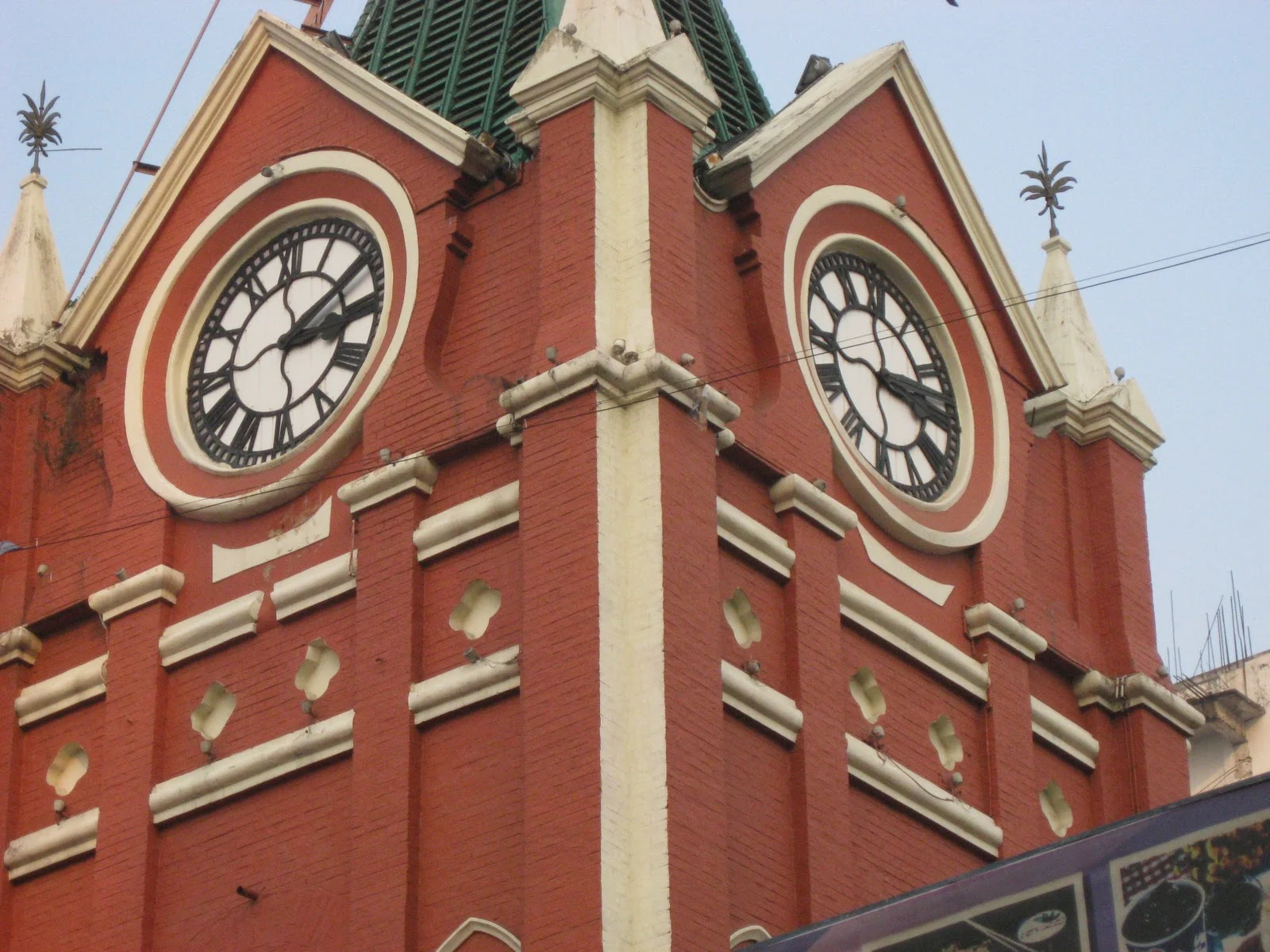
The building itself borrows its bones from an unlikely source, and this is the fact jyethu is proudest of knowing. Architect Richard Roskell Bayne modeled the layout loosely on an English railway platform, giving it the long, covered, single span feel of a train shed rather than a conventional bazaar, a smaller and more ornamented cousin of the same Gothic railway architecture later used at Howrah Station across the river. Bayne's market also replaced an older, smaller bazaar on the same plot known as Fenwick's Bazar, torn down to make way for it, a detail that has all but vanished from popular memory even though it explains why the site was already a functioning marketplace before construction began. The clock inside the tower, incidentally, was not made in India at all. It was shipped over from Huddersfield in England in 1930, replacing whatever timepiece had marked the hours there before.
Jyethu saves his favorite fact for last, mostly because it makes people go quiet. During the Japanese bombing raids on Calcutta in December 1942, vendors and shoppers inside the market ran for cover in the basement of the building itself, or jumped into trenches dug just outside, whenever the air raid sirens sounded. After one raid the drone of the planes faded, everyone climbed back out, and the city discovered it had not actually been bombed that particular night, relieved and slightly baffled in equal measure. The market carried on trading within the hour, which jyethu says tells you more about New Market than any single piece of architecture does.
The bazaar before the bazaar
Jyethu always starts this part the same way, by asking whether we know what stood on Lindsay Street before the market did, and then answering his own question before anyone can guess. Long before the Gothic red brick arcade went up, British residents of Calcutta bought their vegetables, fish, and meat from Lalbazar and Tereti Bazar near the old White Town, and their clothes and luxuries from what was known simply as the Chinese Bazar, run largely by Bengali shopkeepers who served a clientele of Sahibs and Mems.
The arrangement did not last on goodwill alone, jyethu likes to point out, sounding faintly pleased at the pettiness of it. William Hickey, an attorney who lived in Calcutta through the late eighteenth century and left behind an unusually candid set of memoirs, accused those Bengali traders of shortchanging their British customers on both weight and price. Whether the accusation was fair or simply the prejudice of a colonial diarist is something historians still debate, but the rumor stuck, and it became one of the quiet justifications for building a market meant only for Sahibs and Mems.
As the British moved their homes toward Kasaitola, Dharmatala, and Chowringhee, three new markets rose to serve them, Sherbaran Bazar, Chowringhee Bazar, and Chandni Chowk. Sherbaran Bazar stood roughly where the Statesman newspaper office stands today. Chowringhee Bazar, later renamed Dharmatala Bazar after it was auctioned off, was the largest of the three, an 1799 advertisement for its sale describing 207 brick shops, 143 arched shops, and 36 mud warehouses spread across nine bighas, bounded by roads that no longer carry the same names. In 1887 the merchant Jadulal Mallick of Pathuriaghata bought the entire complex.
Sherbaran Bazar and Dharmatala Bazar are both gone now, but Chandni Chowk still trades under that name a short walk away. Alongside these open bazaars stood a handful of English department stores that jyethu insists nobody remembers anymore, Whiteway Laidlaw, the grandest of them, along with Hall and Anderson, the Army and Navy Stores, and Francis Harrison and Haddaway's. Between the haggling of the bazaars and the fixed high prices of the department stores, Calcutta's elite wanted something else entirely, a controlled, hygienic, single roof market built to their own standards.
A garden that vanished
This is the part of the story dida used to tell differently from jyethu, not because she disputed the facts, but because she cared about a different detail entirely, a garden that no longer exists and that she herself never saw either, only heard about from her own mother. In 1863 a group of civilian residents petitioned the Calcutta Corporation for exactly that kind of market. A special committee formed in 1871 approved the plan within months, and twenty five bighas of land at the junction of Lindsay Street and Bertram Street in Chowringhee were purchased for two lakh eighteen thousand rupees. The contractor, Burn and Company, later folded into Mackintosh Burn, began construction almost immediately.
The market that emerged cost six lakh sixty five thousand nine hundred and fifty rupees, a considerable sum for its time, and opened its gates on the first of January 1874, not in September as jyethu says a few careless old records still claim. Its architect, Richard Roskell Bayne of the East Indian Railway Company, was awarded a prize of one thousand rupees for the design, a Victorian Gothic structure of red brick with a clock tower that still looks, against the glass towers surrounding it today, almost apologetically small.
What dida always came back to, though, was a garden nobody in our family has ever actually seen. The market originally faced a proper English garden directly across from its entrance, complete with a fountain, walkways, and benches where shoppers rested between purchases. It was as much a part of the New Market experience as the stalls themselves, according to whatever her own mother once told her. Commercial buildings swallowed the garden decades ago, and no trace of the fountain remains, not even in most local memory, which is perhaps why dida held on to the story of it a little tighter than the rest.
Missed by most first time visitors
- The market building itself is only one part of what people now call New Market. The name has expanded over 150 years to include the entire tangle of surrounding lanes, street stalls, and adjoining complexes like Shreeram Arcade.
- New Market was Kolkata's first municipal market. Six more followed after it, including the College Street Market in 1917 and the Gariahat Road Market in 1938, and none of them ever matched its stature.
- The Corporation actually profited from running these markets until 1968 and 1969, after which the accounts turned unprofitable and have largely stayed that way.
The name Kolkata refused
Ask ten people in Kolkata what New Market's official name is and most will get it wrong, jyethu says, not because they do not know it, but because the city itself has spent over a century refusing to use it. On the second of December 1903, the market was formally renamed Sir Stuart Hogg Market, in honor of the Calcutta Corporation chairman who had pushed hardest for its construction until his retirement in 1866. A bromide portrait of Hogg still hangs today in the Corporation's Portrait Gallery, a small tribute to a man most shoppers walking past his market have never heard of.
The rename never caught on. It was simply new when it opened, so people called it the New Market, and they kept calling it that through the shortened Bengali version, Hogg Shaheber Bajar, the name dida always used, straight into the twenty first century. Even the market's own municipal signage, a blue board near one gate, still lists the old official title in white lettering, largely unread by the thousands who pass beneath it daily assuming it refers to something else entirely.
Dida used to say housewives who bought a saree here told their neighbors precisely where it came from, not out of necessity, but because saying it out loud carried its own quiet prestige.
Nahoum's and the last Baghdadis
This is dida's part of the story more than anyone else's, and chhoto mama tells it the way she used to, down to the pauses. Long before Nahoum and Sons had its own storefront, its founder Nahoum Israel Mordecai, a Baghdadi Jew who arrived in Calcutta to try his luck, sold cheese and baked goods door to door starting in 1902. It took him fourteen years to move into a permanent space inside New Market, and by 1916 the shop that our family would later treat as a Christmas institution had opened for good, its teakwood counters and glass displays barely changed since.
Calcutta at the turn of the century was home to a Baghdadi Jewish community numbering in the thousands, people who had moved along British trading routes through shipping, textiles, and finance. Nahoum Israel Mordecai became one of its most talented confectioners, and the family business passed down through his son Elias, then to David Nahoum who ran it from 1964 until his death in 2013, and finally to his younger brother Isaac. Chhoto mama still remembers being taken there as a boy and being told by dida that the man behind the counter that day was the grandson of the person who started it all.
There is a story that a Kolkata born Jewish scholar named Jael Silliman still tells, one jyethu found written down somewhere years ago and repeats almost the way dida used to repeat her own stories, remembered from childhood Friday dinners, about a customer ordering a Humpty Dumpty cake from Mordecai himself. He baked it, and when he handed it over he pointed out, in his own accented English shaped by decades between Baghdad and Bengal, that he could see the Humpty but was struggling to locate the Dumpty. It is a small joke, almost nothing on paper, but it captures something about a man who built a Kolkata institution while never fully leaving Iraq behind in his voice.
A grander story, one jyethu always adds with a warning that it is probably not true, claims that Geoffrey Fisher, the Archbishop of Canterbury through the 1950s, once tasted Nahoum's fruitcake and praised it publicly. True or not, no one has ever produced a receipt or a photograph to settle it either way, and the bakery has never bothered trying. Fewer than twenty Jewish residents remain in Kolkata today, down from a community that once numbered in the thousands, and Nahoum's is one of the last working traces of it left in the city, and the one part of this whole history that our family actually walked into, year after year, rather than just heard about.
What the fires could not take
Baba remembers the second one, the one in 2011, because a family friend who ran a stall near the fish section lost almost everything in it and would not talk about the market for months afterward. New Market has burned more than once. On the thirteenth of December 1985, a devastating fire tore through large sections of what was then a 111 year old structure, destroying roughly 250 shops and bringing down part of the original heritage building. It was rebuilt, imperfectly, with a mix of the original design and newer materials patched in where needed.
A second major fire struck on the twentieth of July 2011, gutting sections again, including parts of the fish and vegetable market, the one baba's friend never fully recovered from. Shopkeepers at the time pointed to decades old electrical wiring and illegal internal construction as recurring hazards, and the market's dense, narrow corridors have made every fire harder to contain than it should be. Air conditioned malls have opened across the city in the years since, some barely a few minutes away by car, and New Market has kept trading through all of it, rebuilding in the same footprint after every fire instead of relocating, the way baba's friend eventually did too, back into the same lane, a few shops down from where he started.
Cheese, silver, and the guides at the gate
Two cheeses sold almost nowhere else in India can be found inside New Market, and chhoto mama still buys both on the same trip his mother used to make. Kalimpong cheese, made in the hill town of the same name in North Bengal, can be eaten raw or folded into salads. Bandel cheese, a soft, salty, unripened cheese made in perforated containers, originated in a former Portuguese colony in eastern India and carries a texture closer to Surati cheese, though made purely from cow's milk. Both are easy to walk past unless you already know to look for them, which is exactly why our family never has.
For silver work, shops like Chamba Lama have specialized for decades in Tibetan and Himalayan silver curios, a niche within a niche that most tourist guides skip entirely in favor of the saree and jewelry stalls. Baba always adds, whenever the subject of shoes comes up, that Henry Shoes near the leather section has been handcrafting footwear on the same stretch since long before he was born, and that his own father bought his wedding shoes there, a claim nobody has fact checked but nobody in the family doubts either. If you need help navigating the maze of lanes, informal guides known locally as coolies gather near the market entrances and will walk you directly to a specific stall for a small negotiable fee, a system that has operated almost unchanged for generations and works faster than any map, and one dadu apparently used every single time rather than ever learning the lanes himself.
Chhoto mama still insists the Chamba Lama silver counter is where dida once bought a pair of earrings she wore for forty years and never once had cleaned or repaired, treating any suggestion of polishing them as an insult to the shop that made them. Whether that is entirely true or has been improved slightly with each retelling at family gatherings, nobody has ever bothered to check, and nobody plans to.
Quick facts worth knowing before you go
- Land for the market cost two lakh eighteen thousand rupees in 1871, construction added another six lakh sixty five thousand rupees by 1873.
- Architect Richard Roskell Bayne received a personal prize of one thousand rupees for the winning design, modeled loosely on an English railway platform.
- New Market predates every other Corporation run market in Kolkata by at least 29 years.
- The Dharmatala Bazar merchants sued the Calcutta Corporation over the market's construction before it ever opened, the dispute only ended when the Corporation bought out their bazar entirely.
- The 1985 fire alone destroyed roughly 250 shops inside a structure that was already 111 years old at the time.
- Nahoum and Sons operated as a door to door business for fourteen years before it ever had a fixed shop.
- Kalimpong and Bandel cheeses remain two of the few genuinely regional products still sold fresh inside the market rather than packaged for export.
- A working slaughterhouse still operates inside the market complex, a detail almost never mentioned in visitor guides.
The map, and how not to get lost inside it
New Market feels designed to disorient you on purpose, though it was not. Over a century and a half the original single building absorbed street stalls, adjoining arcades, and underground extensions until the whole cluster became one continuous maze with no single logical center. The trick is not to memorize the market. It is to fix two or three landmarks outside it in your head before you go in, since those rarely move even when the lanes inside seem to reshuffle every visit.
Fixed landmarks to anchor yourself by
| Front facade | Faces Lindsay Street directly, red brick with white arched windows and the clock tower, easiest to spot from a distance and the best point to return to if unsure |
| Globe Cinema | A heritage single screen cinema sitting directly opposite the main entrance on Lindsay Street, visible even in heavy crowds |
| Charlie Chaplin Square and the KMC office | Marks the rear approach, near the back entrance reached via Hogg Street, useful if you enter from that side and need to retrace your steps |
| Chaplin Cinema | One of Kolkata's oldest single screen halls, on Hogg Street close to the back entrance, a reliable second marker on that side |
| Free School Street | Runs along one flank of the market and hosts the nearest multi level parking, a good reference point if you arrived by car |
What not to miss, and roughly where to find it
| Nahoum and Sons | Inside one of the interior lanes near the older, central part of the complex, ask any vendor by name and they will point you there, it is the single most asked for direction inside the market |
| Kalimpong and Bandel cheese stalls | Clustered with the dairy and grocery vendors toward the food section rather than the front textile lanes |
| Chamba Lama silver curios | Along the lanes favored by jewelry and curio sellers, generally closer to the front sections nearer Lindsay Street |
| Henry Shoes | Within the leather goods stretch, one of the market's oldest handcrafted footwear sellers |
| The slaughterhouse and meat and fish section | Toward the rear of the complex, closer to the Hogg Street side, easy to smell before you see it and just as easy to avoid if you would rather not |
| Saree and textile stalls | Spread through the busiest central lanes, the loudest and most crowded part of the market at almost any hour |
If you get turned around
Ask for the nearest lane exit by name rather than by direction, most shopkeepers know the lane names cold even if they could not describe a compass bearing. If you came in through the Lindsay Street facade, walking toward increasing daylight and street noise will usually put you back near the clock tower rather than deeper into the covered sections. If you entered from Hogg Street at the back, the Charlie Chaplin Square landmark and the KMC building are visible again the moment you clear the last row of stalls, and from there Esplanade Metro is a short walk. The informal coolie guides at every entrance exist precisely for this problem, and paying one a small fee to walk you back to a specific gate is often faster than retracing your own path.
Planning your visit
| Nearest metro | Esplanade Metro Station, Blue Line, roughly a five minute walk from Exit 2 |
| Timings | Approximately 10:30 am to 8 pm, most shops close on Sundays |
| Time needed | At least two hours for a first visit, longer if you plan to eat and browse |
| Best for | Sarees, footwear, spices, regional cheese, silver curios, festive baking near Christmas |
| Food stops | Nahoum and Sons for baked goods, Nizam's for kathi rolls, Aminia for biryani |
A few practical hacks
Bargain in rounds rather than one shot, walk away once and most vendors will call you back with a better number. Carry small denomination notes since change is often the real negotiation. Visit early on a weekday morning if you want to actually see the architecture rather than just the crowd. If you only have thirty minutes, skip the browsing entirely and go straight to Nahoum's, since the queue near Christmas alone can eat your whole window.
Questions people ask about New Market
Is New Market the same as Hogg Market?
Yes. New Market was officially renamed Sir Stuart Hogg Market in 1903, but the original name stuck so firmly that most Kolkatans still use it, often shortened further to Hogg Market or Hogg Shaheber Bajar in Bengali.
Why is New Market called New Market if it is over 150 years old?
It carried the name simply because it was newer than the bazaars it replaced when it opened in 1874. The provisional nickname outlasted every formal renaming that followed.
What should first time visitors not miss at New Market?
Nahoum and Sons for its history as much as its cakes, the Kalimpong and Bandel cheese counters, and simply walking the original Gothic arcade itself rather than only the surrounding street stalls.
What are New Market's timings and is it open on Sundays?
Most sections run from around 10:30 am to 8 pm, Monday through Saturday, with Saturday sometimes closing earlier in the afternoon. Nearly the entire market shuts on Sundays, including most food stalls.
Is New Market divided into sections?
Yes. Shops are informally clustered by what they sell, sarees and textiles in one stretch, footwear and leather goods in another, meat, fish, and the slaughterhouse toward the rear, and jewelry, silver curios, and confectionery scattered through the front lanes closest to Lindsay Street.
New Market, Lindsay Street, Dharmatala, Kolkata
How wonderful, that clock tower is very British, a shame we never have skies as blue as this.