
In the deep monsoon weeks of Bengal, when the paddies flood and cobras seek shelter on higher ground, an ancient goddess reclaims her dominion. Manasa, the serpent mother, is not the kind of deity who sits quietly in a marble temple waiting to be thanked. She is a goddess who fought for her place in the pantheon, who punished the arrogant, who bent kings through grief, and who ultimately was humbled by the courage of a single young woman on a raft. Her puja is not merely a religious ceremony. It is the living remnant of a 2,000-year-old argument between indigenous folk religion and Brahminical authority, between a river-delta civilization's fear of serpents and its deep intuition that the snake, like the monsoon, is ultimately the source of life.
This guide covers everything from the 2026 puja dates and ritual steps to the lesser-known dimensions of Manasa worship that most articles miss entirely. Read it before, during, or after the festival, and you will know this goddess as few do.
Who is Goddess Manasa: Origin, Names and Identity
Manasa is the Hindu goddess of snakes, fertility and prosperity. She is worshipped primarily in Bengal, Assam, Bihar, Odisha, Jharkhand and parts of Uttarakhand for protection from snakebite, blessings of children, healing of disease, and the granting of wealth. Yet behind this functional description lies one of the most psychologically complex goddesses in the entire Hindu tradition.
In the Puranas, Manasa emerged from the mind of sage Kashyapa while he was composing a mantra for the removal of snake venom at Brahma's request. Because she emerged from his mind (Sanskrit: manas), she was named Manasa. The Manasamangal Kavya, Bengal's own literary tradition, gives a slightly different account, presenting her as the daughter of Shiva himself by a second wife. This dual parentage is significant: it is the very source of her conflicts, her sense of being only partially accepted, and her wrathful determination to be recognized.
Her stepmother Chandi, identified in this context with Parvati, despised her. Her husband Jaratkaru was a sage who had vowed celibacy and consented to marriage only on conditions. When Manasa woke him one morning thinking he had missed his worship time, he abandoned her in anger. Her father Shiva did not fully embrace her. This repeated rejection by the most powerful figures in her life shaped a goddess who craves recognition, protects ferociously, and has almost no tolerance for those who dismiss her.
The Many Names of Manasa Devi
She carries many names across the regions and texts, each reflecting a different dimension of her power:
It is worth noting that the insult Chand Sadagar hurled at her in the Manasamangal, calling her a one-eyed wretch, has been preserved in the text for centuries. This is unusual in devotional literature. Scholars read it as a sign that the Kavya was composed with remarkable honesty about the messy, contested, politically charged nature of establishing a new cult in a society that already had its favourite deities.
The Pre-Aryan Roots: Manasa Before the Puranas
Manasa is widely considered to be a pre-Aryan goddess. Archaeological evidence from the Bankura district of West Bengal traces serpent worship traditions that predate organized Hinduism, with some connections drawn to practices from the Indus Valley Civilization. Over 48 images of Manasa have been discovered from North Bengal alone, with some believed to date to the Gupta period in the fifth or sixth century CE.
The earliest two-armed idols of Manasa from Mangalkot in Bogra are considered the oldest known, holding the son Astika in one hand and a pot in the other, with a crown of expanded serpent hoods. These iconographic features are indigenous in origin, reflecting a local tradition of snake worship entirely separate from the Vedic religious system.
Manasa's victory over Chand Sadagar is not just one man's conversion. It represents the victory of the indigenous, non-Aryan deity over the Aryan Brahminical religious order, a battle fought not with weapons but with human suffering and love.
Banglapedia, National Encyclopedia of BangladeshThe process scholars call Sanskritization, the gradual absorption of folk and tribal deities into the mainstream Hindu framework, is written into Manasa's very biography. She went from being a village snake goddess worshipped at a thorny plant in the courtyard to being given a lineage connected to Kashyapa, Vasuki and the Mahabharata. Her son Astika appears in the Mahabharata in a pivotal moment, halting the mass serpent sacrifice of King Janamejaya. By connecting Manasa to a Mahabharata hero, she was granted a Brahminical passport into the Sanskrit literary world.
Even so, the lived practice of Manasa Puja never became a fully Brahminical affair. In many regions, a priest is not required. The oldest women of the household lead the ritual. The offerings are stale, cooked the previous night. The goddess is sometimes represented by nothing more than a pot, a thorny plant, or a sketch in the courtyard mud. This informality is one of the defining characteristics that marks her as a goddess of the people, not of the temple establishment.
The Manasamangal Kavya: Bengal's Ancient Epic of Defiance
The Manasamangal Kavya is recognized as the oldest of the Bengali Mangal-Kavyas, the genre of devotional narrative poems that emerged in Bengal between the thirteenth and eighteenth centuries. These poems were composed in praise of regional deities and were meant to be sung in performance by a lead singer called a Gayen, accompanied by a chorus of Dohars, throughout the night during the puja season.
The first Manasamangal poet is believed to have been Kana Haridatta of Barisal, writing around the thirteenth century, though his work is no longer extant. The versions that survive include Vijaya Gupta's Manasamangal of 1494, also known as the Padmapuran, and Bipradas Pipilai's Manasa Vijaya of 1495. Vijaya Gupta's version is especially important because it has preserved details of the medieval merchant trade routes of Bengal, the seafaring economy of the delta, and the social hierarchies of the era.
The Structure of a Mangal-Kavya
Every Mangal-Kavya had four parts. The Vandana, a salutation to multiple deities regardless of caste or religion, showing the non-communal outlook of the composers. The Poet's Introduction, where the poet explains how he received divine inspiration, often through a dream or vision. The Central Narrative, the legend of the deity. And the Phalaśruti, a statement of the merit gained by listening to the text.
The Kavya is not a simple devotional text. It is, at its core, a story about power, about who gets to be called a god, about what it costs ordinary people when divine politics plays out in their lives. The merchant Chand Sadagar is not a villain. He is portrayed as a man of honour who simply refuses to add another deity to his already complete devotional world. His tragedy is that his refusal costs his sons their lives.
What scholars find extraordinary about the Manasamangal is its unflinching portrayal of the goddess as capable of cruelty. She destroys seven of Chand's ships. She kills his sons one by one. She even manipulates the divine architect Vishwakarma into leaving a gap in the iron bridal chamber so her snake can enter. She orchestrates the births of Behula and Lakhindar. The Kavya presents her not as a perfectly benevolent deity but as a goddess who uses every means available, including terrible ones, to achieve recognition. This makes her one of the most psychologically realistic figures in all of medieval Indian literature.
Behula and Lakhindar: The Love Story that Founded a Goddess
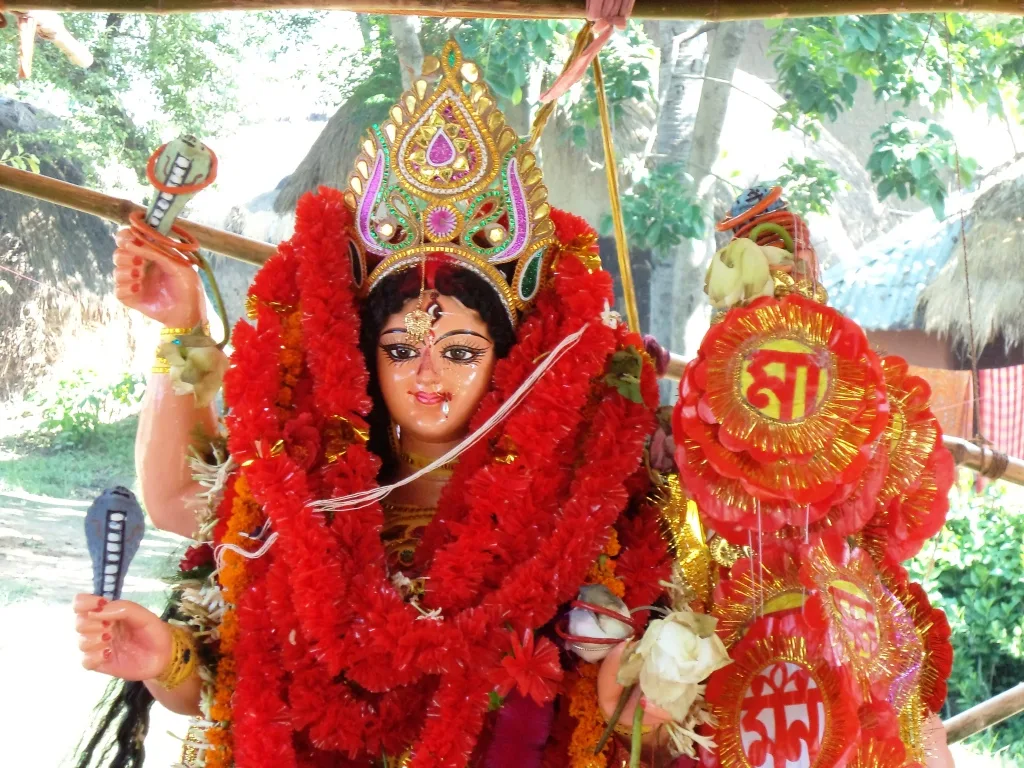
The story of Behula and Lakhindar is one of the most enduring tales in the entire Bengali literary tradition, known to virtually every Bengali person across generations, across classes, and across religions. At its heart, it is a love story. But embedded within it are arguments about gender, power, divine authority, and what human beings owe to gods who demand their suffering.
The Background: Chand Sadagar's Defiance
Chand Sadagar was among the wealthiest merchants of Champak Nagar in the ancient Anga region, the area around present-day Bhagalpur in Bihar. He was a devoted worshipper of Shiva, and Manasa desired his worship above all others, because she believed that if even this most adamant Shiva devotee could be made to acknowledge her, her place in the divine order would be secured.
Manasa destroyed his seven ships laden with goods. She killed six of his seven sons through snakebite. Chand still refused to worship her. His refusal was not born of ignorance but of principle, a man who had given his devotion to one deity and would not have it coerced away.
The Iron Chamber and the Wedding Night
To protect his last surviving son Lakhindar, Chand had the divine architect Vishwakarma construct a completely sealed iron chamber for the wedding night, a structure without a single gap or hole. The Merghar, as this structure is known, was designed to be impenetrable to any snake. Vishwakarma built it perfectly, but when Manasa appealed to him, he left one small hole near the ceiling.
Lakhindar and Behula were married. On their wedding night, Manasa sent her most potent snake, Kalnagini. There is a particularly striking detail in the text: Kalnagini, approaching the sleeping couple, noticed that Behula had committed no sin deserving of such punishment. She hesitated. She could not bring herself to kill Lakhindar without first marking Behula with some moral taint. So she used her tail to smear the parting of Behula's hair with oil from the lamp nearby, a gesture considered sinful for a newly wed woman. Only after this act did she bite Lakhindar. When he cried out, Behula woke and threw her jaanti, cutting off the lower part of Kalnagini's body. But the damage was done.
The Raft, the River and Nine Months of Devotion
By custom in this tradition, the body of a person who died from snakebite was not cremated but was set afloat on a raft. The hope was always that the river, or divine intervention, might restore life. Behula refused to leave her husband's side. Despite the decomposition of the body, despite the disbelief and pleas of her family and community, she remained on the raft.
She sailed for six months, passing village after village. Some accounts say nine months. Along the way she encountered Neta, Manasa's elder sister, who was washing clothes on the riverbank. When a child kept troubling Neta, the old woman in irritation splashed water on him, and he died. Then she splashed water again, and he lived. Behula understood immediately that this woman could restore Lakhindar. She appealed to Neta, who was moved by her devotion and brought her and Lakhindar's corpse to the celestial realm.
The journey of Behula to revive her dead husband has been seen for centuries as a triumph over the fear of death from snakebite. This belief is the emotional core of the entire Manasa cult.
Research on Popular Memory of Behula's Pilgrimage, ResearchGate, 2022The Dance and the Bargain
In the celestial realm, Behula danced before the gods. Her dancing was so extraordinary that the gods agreed to restore Lakhindar and the other six brothers, on one condition: she had to get Chand Sadagar to offer anjali to Manasa with his right hand. Chand had sworn that his right hand, which he used for offerings to Shiva alone, would never worship Manasa. He yielded only enough to offer a single flower, with his left hand, while looking away. It was a gesture barely acknowledging her at all. But Manasa, who had struggled so long and so painfully for any recognition from this man, accepted it. She restored all seven sons, the ships and Chand's fortunes.
Archaeological Echoes
These are not purely mythological figures. Archaeological sites around Bogra district in Bangladesh carry names directly from the Manasamangal story: Basar Ghar of Behula and Lakhindar, Netai Dhopanir Pat, Ojha Dhanwantorir Bhita, Chander Bari and Chander Dhap. The Gokul Medh ruins near Bogra, dating to the eleventh century, are locally identified as the bridal chamber of Behula and Lakhindar. The Behala locality of Kolkata is believed by some to derive its name from Behular Ghat, the ghat of Behula. Communities in these areas claim descent from Chand or other characters from the narrative. The story has left marks not just in texts and rituals but in the landscape itself.
The Ritual Calendar: When and How Manasa is Worshipped
Manasa Puja is not a single-day event. It is a season that stretches across the monsoon months, following the logic that the goddess must be propitiated when her subjects, the snakes, are most active. From the Dasahar of Jyaishtha to the Ashwin Sankranti, Manasa receives ritual attention across several fixed dates.
Panchami in the month of Ashar. First significant regional observance of Manasa Puja in some parts of Bengal and Assam, marking the beginning of the puja season.
Second observance of the puja season. In communities following the Bangal tradition (originally from East Bengal), this date is particularly significant.
Third observance, falling in the month of Shravan. Rituals include Manasa Ghot worship and recitation of the Manasamangal Panchali.
Nag Panchami (Shravan Shukla Panchami). The most widely observed date for Manasa Puja across all regions. Women observe a fast. Milk is offered at snake holes. This is the major public observance day.
Fifth regional observance. Some communities hold extended rituals on this date, particularly in tribal areas.
Bhadra Sankranti, the last and most distinctive date. This is the Ranna Puja or Arandhan day, when no new cooking takes place, and food offered to Manasa is shared communally. In the form of Jagadgauri Manasa, the goddess receives her harvest-season worship. This is also the eve of Vishwakarma Puja.
The Bangal vs Ghati Distinction
A fascinating cultural divide within the Bengali community affects Manasa Puja timing. Bangals, families originally from East Bengal (now Bangladesh), traditionally worship Manasa in the month of Shravan. Ghatis, families from West Bengal, traditionally worship in Bhadra. Those who have families from both traditions observe both dates. This is a living marker of the partition's cultural legacy, with the two communities maintaining their distinct puja calendars even generations later.

Manasa Puja Vidhi: Rituals, Offerings and Sacred Objects
One of Manasa's most distinctive ritual characteristics is that she is frequently worshipped without an image. Unlike most major Hindu deities who require an idol or murti, Manasa is often represented by a clay pot (Manasa Ghot), a tree branch, an earthen mound, or simply a clay image of a serpent. This aniconic tradition reflects her pre-Aryan origins and the folk character of her cult.
Ranna Puja and Arandhan: The Day the Stove Goes Cold
Of all the forms of Manasa Puja, the Ranna Puja of Bhadra Sankranti is the one most deeply woven into the daily domestic life of rural Bengal, and yet it is among the least written about in English. The word Arandhan means literally not cooking. On this day, which falls on September 16 in 2026, no new cooking takes place in the household.
The evening before, the women of the house prepare a feast. They cook multiple dishes, clean the kitchen with special care, and then offer the meal to Goddess Manasa, specifically in her form as Jagadgauri Manasa. The food is left overnight. On the day of the festival, the stove remains cold. The family eats only the food prepared the previous evening, now stale. This is not an accident or a hardship but the precise requirement of the ritual.
The deeper meaning is layered. The monsoon is ending. The first rice of the new season is appearing in the fields. Farmers are emerging from the hardest weeks of the agricultural year. The festival is both a thanksgiving to the goddess who presided over the dangerous snake season, and an acknowledgment that the earth has provided abundance again. By choosing not to cook, the family is simultaneously honouring the kitchen as a sacred space, thanking the previous year's grain that has sustained them, and welcoming the new harvest by resting the hearth.
In many households, this is also the day when the unun (the traditional clay cooking stove) itself is worshipped. The Manasa Daal, a branch of the Sij plant, is placed in or near the unun. The oldest woman who can read performs the worship. No Brahmin is needed. This is a women's ritual, conducted by women, for the wellbeing of the household.
The Ranna Puja Connection to Vishwakarma Puja
Ranna Puja falls the evening before Vishwakarma Puja, the day when artisans and factory workers worship the divine craftsman. This pairing is not accidental. One festival honours the hearth, the domestic productive space. The other honours the workshop, the external productive space. Together they reflect a complete picture of a community's productive life, with Manasa presiding over the domestic sphere.
Regional Variations: From Bengal to Assam to Bhagalpur
The Phanimansa Plant: A Living Form of the Goddess
Few aspects of Manasa Puja are as botanically and ritually fascinating as the central role of the Phanimansa plant. Known scientifically as Euphorbia lingularia, this wild plant with thick, spiky, thorn-edged leaves grows in the courtyards and margins of rural homes across Bengal and Assam. It is believed to be the favourite haunt of snakes, which is precisely why it is considered sacred to the serpent goddess.
In the ritual tradition, this plant is understood as the living, embodied form of the goddess. In the Manasamangal Kavya, there is a theological statement that Manasa transformed her energy in her ripe age into this plant form for the greater benefit of ordinary people. The plant has medicinal properties, said to be effective against phlegm and tumors.
The Manasa Thaan in the courtyard of a traditional Bengal home is built around the Sij plant. A raised earthen or concrete mound is constructed around its base. The clay Manasa Ghot is placed at the mound. The branches of this plant are used to decorate the pot during the puja. Women worship here in the mornings, offering a little water and incense, maintaining what is essentially a daily, informal version of the goddess's puja year-round.
In tribal communities of West Bengal, Jharkhand, and Assam, the Manasa Thaan centered on this plant is present in every household. It is not a special festival installation but a permanent feature of the home. This points to Manasa's most fundamental character: not as a festival deity who is installed and then immersed, but as a resident household presence whose goodwill must be continuously maintained.
Lesser-Known Facts and Hidden Dimensions of Manasa Worship
Beyond the main narrative and ritual calendar, Manasa's world contains remarkable dimensions that rarely appear in any standard account. These are the details that reveal the true depth and strangeness of one of India's oldest living cults.
Manasa is Worshipped by Muslims
Manasa worship crosses religious boundaries in ways that are almost unparalleled among Hindu deities. In both Bengal and Assam, Muslim communities are active participants in her performance traditions. Muslim artists in Bengal paint her story-scrolls (pats) and sing her narratives. Muslim artisans in Assam design Manasa's pith paintings, the intricate figures made from sola (a natural reed fibre). The Bedey community, traditionally nomadic snake charmers who are now predominantly Muslim, remains among the most fervent worshippers of Manasa. This was documented by researchers as an example of cultural assimilation and folk syncretism that predates and has outlasted formal religious divisions.
The Bhog Must Be Stale
Most Hindu deities are offered fresh food as a sign of respect. For Manasa, the bhog is cooked the previous night and offered in the morning when it is already old. This requirement, which appears at first glance to be an insult to the goddess, actually encodes a very old theological idea: that Manasa belongs to a category of deities who preside over realms associated with the previous day, the past, and the night. The stale offering marks her as a deity connected to death, transformation and the cyclical renewal of things that have already been consumed.
Body Piercing as Devotion
In some regions, particularly during peak monsoon puja season, devotees pierce their bodies with metal rods or skewers to demonstrate the depth of their devotion and to seek the goddess's protection from snakebite. This practice is not confined to a single caste or community and represents one of the more physically intense aspects of folk worship that connects Manasa's cult to similar practices seen in South Indian festivals.
Live Snakes in Performance
A major highlight of Manasa Puja in certain areas is the use of live snakes in theatrical performances depicting the story of Manasa Devi. Snake charmers, historically associated with the Bedey community, bring real cobras and other serpents to the performances, creating a direct, visceral connection between the goddess's mythology and her actual subjects. This tradition is now considerably rarer than it once was.
Manasa as Healer of Smallpox
Manasa is not only the goddess of snakebite. She is also revered as a healer of infectious diseases, including smallpox and chicken pox. This dimension of her power reflects a pre-modern understanding of the snake as a creature connected to both poison and medicine, to both disease and its cure. The folk category of afflictions for which Manasa is propitiated includes any sudden, apparently inexplicable illness that arrives and departs like a visiting force from outside the human world.
The Infertility Prayer
Women who have been unable to conceive come to Manasa for the boon of children. The ritual is called Manasar-Bari Puja, worship of the Manasa-House or Manasa-Abode. Women worship the goddess with a simple Ghot under the Sij tree branch, asking for the blessing of motherhood. This fertility dimension of Manasa's worship connects her to the earth-goddess traditions that predate the snake-goddess mythology entirely.
The Left-Handed Offering of Chand Sadagar
One of the most fascinating theological details in the entire Manasa tradition is that Chand Sadagar, when he finally conceded to worship Manasa, did so with his left hand, while looking away, and offered only a single flower. He did not give his right hand, which was reserved for Shiva. He did not look at her face. He made the absolute minimum gesture imaginable. And yet Manasa accepted it. Some scholars read this as evidence of the goddess's essential vulnerability and hunger for recognition, no matter how incomplete. Others read it as a sophisticated theological statement: that even the most grudging acknowledgment of the divine is enough to begin the relationship. Either way, the left-handed flower is among the most memorable images in all of Indian devotional literature.
The Behala Locality of Kolkata
The southwestern Kolkata neighbourhood of Behala is believed by local tradition to derive its name from Behular Ghat, the riverside landing point associated with Behula's mythological journey. Communities in the area maintained this oral tradition for generations, and while it cannot be definitively verified, it represents the way the Manasamangal geography has been mapped onto the actual landscape of Bengal, making the myth not just a story but a guide to place.
Manasa and the Mahabharata Connection
The Mahabharata does not mention Manasa directly, but it contains her son Astika in a pivotal episode. King Janamejaya, whose father Parikshit was killed by the serpent Takshaka, organized a massive sarpa satra, a sacrifice designed to exterminate the entire naga race. Astika, son of the sage Jaratkaru and the naga princess Manasa (here called Jaratkaru), interrupted the sacrifice and saved the naga lineage. The connection between Manasa and this Mahabharata episode was the theological bridge that gave her cult its legitimacy within the Sanskrit canon. It also places Manasa's story at the intersection of the two great concerns of her region: serpent worship and the fear of total destruction by fire.
The Deodhani Dance: Shamanism, Possession and the Sword
Of all the regional variations of Manasa worship, the Deodhani ritual of Assam stands apart as one of the most extraordinary surviving examples of shamanistic practice in the Hindu world. It is performed primarily by male Deodhas, ritual specialists who are believed to become vehicles for the goddess herself during the ceremony.
The performance begins with preparation and purification. The Deodhas fast, bathe in sacred rivers, and enter a meditative state. As the ritual progresses, with drumming, chanting and the building invocation of Manasa's name, the Deodhas begin to enter states of trance possession. At the peak of possession, they may perform acts that would be physically impossible or extremely dangerous in a normal state of consciousness.
These acts, documented in ethnographic studies, can include jumping on the blades of swords, consuming raw meat or blood from sacrificed animals (goats or pigeons), and exhibiting feats of physical endurance that participants interpret as proof of divine inhabitation. The Deodha in this moment is not performing: in the ritual framework of the community, he is the goddess, embodied and present.
This practice is found in particularly vivid form among indigenous communities including the Ahoms, Bodos and Rabhas of Assam, communities where the absorption of Manasa worship into pre-existing shamanistic frameworks produced a result very different from the Brahminical rituals of Bengal. The Deodhani tradition has been studied by scholars including Hugh B. Urban of Ohio State University, who analyzed the gender dynamics of male bodies entering possession by a female deity.
Art, Craft and Performance: How Manasa Lives in Bengali Culture
Manasa Puja has generated one of the richest bodies of folk art and performance in the entire Indian tradition. Her story has been told through every medium available to Bengali and Assamese artists for at least seven hundred years, and several of these traditions continue today.
Patachitra and Pata Painting
The Patachitra tradition of Bengal uses long horizontal scrolls (pats) to narrate stories with painted images and sung commentary. Manasamangal patachitras dating to the eighteenth century have survived, and the tradition continues in present times. Both Hindu and Muslim artists from the Chitrakar community create these scrolls, demonstrating again the cross-religious character of Manasa's cultural legacy.
Manjusha Chitrakatha of Bhagalpur
Bhagalpur's unique folk art form, the Manjusha Chitrakatha, is devoted entirely to the Manasa legend. These painted boxes with serpentine motifs tell the story of Behula and Lakhindar in a distinctive visual language. The art form is closely tied to the four-day festival held in Bhagalpur every August and has been documented as one of the few folk art traditions completely dedicated to a single mythological cycle.
Sola Craft Figures
Sola, a light fibrous reed grown in Bengal's wetlands, is used by artisans to create elaborate Manasa figurines. In Assam, Muslim sola artisans craft Manasa's ritual depictions. The craft is in decline due to economic pressures and the availability of cheaper manufactured alternatives, and cultural preservation efforts are underway to sustain it.
Bhashan Gaan and Manasa Pala
The Bhashan Gaan is a form of folk theatre directly named after Behula's floating journey on the river. The word Bhashan means floating or immersion. The performance is a complete Pala Gaan, a narrative performance involving a lead singer (Gayen) and chorus singers (Dohars), incorporating acting, dancing and music. It begins in the evening and continues through the night, ending at dawn. It is both a retelling of the Manasamangal story and an act of worship in itself.
Terracotta Manasa Figures of Bankura
Bankura district's terracotta artisans produce distinctive clay Manasa figures that have been studied by archaeologists and art historians as a continuous tradition connecting the Gupta-period stone images to the present. These figures are ritual objects, not merely decorative, and the process of their creation is governed by the same ritual calendar as the puja itself.
Important Temples Dedicated to Goddess Manasa
Manasa is primarily a household and village goddess, but she also has important temple presences across India.
Champanagar Temple, Bhagalpur, Bihar
In the old quarters of Bhagalpur's Champanagar neighbourhood stands what devotees believe is the most ancient and sacred Manasa temple, built near the site where Chand Sadagar is said to have had his mansion. Local tradition holds that artefacts and sculptures discovered in the area are from his era. The temple hosts the major four-day festival in August and draws pilgrims from Bihar, Bengal and Jharkhand.
Manasa Devi Temple, Haridwar, Uttarakhand
Perched on Bilwa Parvat in Haridwar, this temple is accessible by a cable car or a forest trek. It contains two main idols, one with three mouths and five arms, another with eight arms. The wish-fulfilling thread-tying ritual here draws lakhs of pilgrims annually, particularly during Navratri, Shravan and Kumbh Mela. It is part of the Tridevi Darshan circuit along with Chandi Devi and Maya Devi.
Manasha Puja at Lala Bagan, Kolkata
The Manasa Devi Mandir at Lala Bagan on Simla Street in Kolkata has been conducting Manasa worship between November and February every year for over 120 years, which is unusual given that the canonical puja season is monsoon. This winter worship reflects a parallel tradition of Manasa as a year-round household protector rather than solely a monsoon goddess.
Manasavaram, Karimnagar, Telangana
The Shri Manasa Devi Temple at Kasimpet, called Manasavaram, in Karimnagar district of Telangana is a swayambhu (self-manifested) temple with a significant regional following, demonstrating that Manasa's presence extends well beyond her eastern heartland into South India.