Darjeeling - Toy Train, Hotels and Pujo Vacation in the Hills
Darjeeling does not announce itself. It arrives in pieces: a cold edge in the air somewhere past Siliguri, tea bushes stitched across a slope like green corduroy, a narrow-gauge whistle bouncing off a wall of fog, and then, on one clear morning, five peaks of Kanchenjunga standing in the sky as if they had been there before the world was finished. This is the story of three days in that town, told hour by hour, with everything you need to plan your own: the toy train and how to book it, where to sleep, what to eat, which month to choose, and the small realities that no brochure mentions.
Best time: October to early December and March to May for clear peaks.
Days needed: 3 days for the essentials, 5 days to include Mirik, a tea estate and a short trek.
Getting there: Bagdogra Airport (IXB) or New Jalpaiguri (NJP) station, then a shared jeep or taxi uphill.
Toy train: The Joy Ride from Darjeeling to Ghum and back is the one most visitors book; seats sell fast in season.
Stay: Mall Road and Chowrasta for walkability, the ridges for views and silence.
Durga Puja in Darjeeling: Drums in the Mist
The Bengali festival in the hills
Bengali families have lived in Darjeeling for generations, and when the lunar calendar turns toward Durga Puja, in late September or October, they bring the festival of the plains up the mountain with them. Bamboo frames rise on open ground and beside old clubs, canvas and cloth go up in red, white and gold, and by the evening of Shashthi the idol of Durga stands in the lamplight with her ten arms raised, the lion at her feet and the demon beneath her spear. Her eyes are large and calm. The cold air carries incense, marigold and the sweet smoke of frying.
Then the days begin to move to the rhythm of the dhak. The great drums start before the evening aarti, and their deep beat rolls across the ridge and comes back from the valley, so that the whole town seems to be tapping the same pulse. Women in white saris with red borders carry brass plates of flowers to the morning anjali. Men in crisp kurtas queue for bhog, the khichuri and mixed vegetables ladled onto leaf plates and eaten sitting on long benches with a jacket pulled tight against the chill. At night the dhunuchi dancers sway with smoking clay burners in their hands, the fragrant haze drifting up into the pine, and the mist wraps each pandal in a halo until the lights seem to float.
The festival is smaller here than in the great cities of the plains, and gentler. Pandals sit close to the lanes, the lamps are fewer, and visitors can stand near the idol without a crowd pushing from behind. On the last day, Dashami, the married women press vermilion on each other's faces in a laughing red farewell, and the idol leaves in a slow procession toward the water, drums beating, as the lamps go out one by one along the lane. Wherever you stay, find an evening to walk through one of these pandals. It is among the most vivid and welcoming sights the hills offer, and it asks nothing of you but a quiet step and an open hand for prasad.
The tourist surge
The festival holidays are also one of the busiest stretches of the Darjeeling year. Families from the plains climb the mountain in long convoys, and the town changes shape within days. Rooms that sat empty in September fill weeks ahead, prices rise, and the better heritage and ridge stays disappear first. Steam Joy Ride seats vanish from the booking screen soon after the window opens. The queue of jeeps at Jorebungalow thickens before three in the morning, Tiger Hill's railing is shoulder to shoulder, and Mall Road at dusk moves at the speed of its slowest stroller, with shawl-sellers, momo vendors and photographers wedged into the same lane.
There is a gift inside the crush, because these are also the clearest weeks of the year. The air is rinsed after the monsoon, and Kanchenjunga stands sharp and white above the ridge on many mornings. The way to enjoy it is to move against the crowd. Book your room and toy train seat as early as the booking window allows. Take the first departure of the day on every outing, when the light is clear and the lanes are empty. Choose a ridge or a tea estate stay, away from the central bazaar, and keep pandal visits for the evening, when the drums begin. Weekdays are calmer than the long weekends around the main days of the festival.
Day One: The Climb, the Whistle and the First Evening
The road up from the plains
The plains let go of you slowly. Past Siliguri the road begins to tilt, the air loses its weight, and the sal forests of the Terai fold into the first proper bends. Shared jeeps wait outside Bagdogra Airport and New Jalpaiguri station, packed tight, drivers calling out one word over and over: Darjeeling. A private taxi costs more but gives you room for bags and a window to yourself. Either way, expect the drive to run roughly three to four hours, longer if a landslide has slowed the road or the morning traffic around Siliguri and Kurseong has thickened. Luggage space in a shared jeep is limited, so pack soft bags and keep a jacket within reach, because the temperature falls with every hairpin.
Somewhere near Kurseong the first wisp of cloud crosses the road. Tea gardens begin on both sides. The jeep leans into a curve, and a thin blue line on the right turns out to be the toy train track, running alongside the road, crossing it, disappearing, returning, as if the railway and the road were old companions who could never quite agree on a route.
A broken engine at Kurseong
Some travellers meet the toy train in Kurseong, hoping to ride its small blue carriages the rest of the way to Darjeeling. The station there is a low old building with a long platform, and on a quiet afternoon it belongs to goats. They leap over the rails as if the narrow gauge were built for their games, while dogs doze in the sun and a scruffy puppy tries to burrow inside your jacket as if it had every right. The ticket window is shuttered, no one seems to know the timings, and then word drifts along the platform: the locomotive has failed, the repair will take hours, and the next departure is not until evening.
That is the moment the road takes over. Bags go back on shoulders and the walk begins to the roadside, where jeeps heading uphill pass either full or pointed the wrong way. A local standing nearby, who turns out to be an off-duty policeman, names the fair price for a shared seat to Darjeeling and flags down a jeep himself. You end up wedged into the back among sacks and strangers, climbing into colder air with the tea slopes sliding past. Keep this in your plan: the toy train is a heritage ride, not a timetable you can lean on, and a shared jeep from Kurseong or Siliguri is the fallback that always leaves.
Arriving in town
Darjeeling sits at about 2,000 metres, draped over a ridge so steeply that houses seem to hang from each other's shoulders. The jeeps usually end their climb near the stand close to the Clubside area, and from there the town takes over. Porters in worn jackets offer to carry your bags up the lanes. Some hotels sit on walking-only stretches where no taxi can reach the door, so a short climb with luggage may be part of your arrival. Ask your hotel how the last stretch works before you book, and you will save yourself a breathless surprise.

Darjeeling is not a town in a valley. It is a town on the flank of a mountain, built so steeply that a house can have its ground floor on one lane while its roof sits level with the street above. Colour does the work that order cannot: turquoise and sea-green walls, orange and pink flowers planted in old plastic bags and tins, and behind them the deep emerald of forest that never quite stops growing. In the centre, one main road carries more cars than it was ever drawn for, horns echoing off the walls, jeeps edging bumper to bumper, and only a steaming toy train rolling through the middle would make the scene complete. A few lanes above or below that noise, the town changes completely. Schoolchildren in perfect uniforms and neat ties climb the stairs in twos and threes, and the lanes fall quiet enough to hear a radio from an upstairs window.
Best Hotels in Darjeeling: Where to Stay by Area
The town divides itself by mood. Choose the mood and the hotel follows.
| Area | Best for | What it feels like | Practical note |
|---|---|---|---|
| Mall Road and Chowrasta | First-time visitors, families | Shops, cafés and the evening crowd within a short walk | Busy at night, some lanes are walking-only |
| Observatory Hill and the upper ridges | Couples, photographers | Quiet mornings, prayer flags, long views when the sky clears | Steep walks back to town in the evening |
| Lebong and the lower slopes | Slow travellers, tea lovers | Gardens, birdsong, distance from the crowd | A taxi becomes necessary for town trips |
| Ghum | Monastery and train enthusiasts | Cooler, quieter, closer to the highest station | Further from Mall Road restaurants |
Three tiers of stay
Colonial heritage and luxury. Old planter bungalows and hill club buildings with wood-panelled lounges, fireplaces and verandahs where tea arrives on trays. Windamere, Elgin and Mayfair are the names most often spoken, each carrying a different flavour of the Raj era. The charm here is the creak of old floorboards and the hush of the garden at dusk.
Mid-range and tea estate homestays. Estates such as Makaibari and Singtom open rooms to guests, and boutique stays around Lebong offer a quieter slope and a host who knows which morning the mist will lift. Breakfast is often on a verandah above the tea rows, with first flush in the cup.
Backpacker and budget. Hostels and small lodges cluster near Gandhi Road and Mall Road. They are close to everything, friendly and plain. In winter, ask two things before booking: whether the geyser works reliably and whether the room has a heater, because a cold bathroom at six in the morning is the one thing a hill station budget can punish.
Hotel comparison at a glance
| Tier | Examples | Price band | Location and access | Heating and hot water |
|---|---|---|---|---|
| Heritage and luxury | Windamere, Elgin, Mayfair | Premium, well above the mid-range band | Close to the ridge and town, usually with a vehicle approach to the gate | Fireplaces and room heaters are part of the stay; confirm for your dates |
| Mid-range and tea estate homestays | Makaibari, Singtom, boutique stays near Lebong | Roughly ₹2,000 to ₹5,000 a night | Quiet slopes; a taxi is needed for trips into town | Heater on request; ask how reliable the geyser is |
| Budget and backpacker | Hostels and lodges off Gandhi Road and Mall Road | Under about ₹2,000 a night | Central, often on walking-only lanes | Hot water can run on a timer; ask before you pay |
Which area suits which traveller
Couples will love the ridges around Observatory Hill and the tea estate homestays, where mornings begin with mist at the window and breakfast on a verandah. Families do best around Mall Road and Chowrasta, with restaurants, shops and the evening square a few steps from the door. Photographers should ask for an east-facing room on the ridge, because the first gold on Kanchenjunga arrives at the window before the kettle has boiled; Ghum works too for anyone chasing the toy train in early light. Rail enthusiasts sleep best near Ghum, within earshot of the whistle.
Finding the right room
Rooms in Darjeeling are rarely won on the first try. A guesthouse praised in a guidebook may quote three times the printed rate, and the person at the desk will not move on the price. The better find comes from walking the lanes, knocking on gates and reading hand-painted signs. At the bottom of one iron gate and a short flight of stairs, a small family lodge opens into a sitting room where a smiling grandfather shows you the spare room before he mentions a rate: a big bed under a heavy quilt, tall windows, a little balcony facing the ridge, and furnishings that look inherited from a grandmother. The geyser works. That one detail decides the stay more than any star rating.
The first evening
As the light drops, the town changes costume. Lamps come on along Mall Road. Woollen caps, shawls and handknit scarves appear in every shop doorway. At Chowrasta, the open square at the top, families lean on the railings and watch the last pink on the ridge fade to grey. A pony walks past with a child on its back. A man sells roasted corn from a basket. Nobody hurries, and by the time the clouds settle into the valley below you, you have stopped hurrying too.
Dinner belongs to the hills. Steamed momos with a red chilli chutney that clears the sinuses, thukpa in a broth thick enough to hold a spoon upright, and a bowl of Nepali thali with dal, greens, pickle and rice. Later, a cup of Darjeeling tea, pale gold, slightly floral, tasting nothing like the sweet milky tea of the plains. Sleep comes easily at this height, under two blankets, with the window cracked open to a silence broken only by a dog barking somewhere far below.
Breakfast on another morning is Tibetan bread, soft and a little chewy, torn by hand and dipped into a steaming bowl of thukpa broth or a spoonful of spiced vegetable curry, eaten at a plastic table in a lane where the steam from the kitchen fogs the window and the cook never stops folding dough.
Dinner on another night is a plain thali in a small family eatery where the owner greets you as if you had been expected. A steel plate arrives crowded with rice, potatoes, mustard greens, a ladle of dal, sharp pickle and a few green chillies, and eating with your fingers in the warmth of a low room, with the glass of the window fogged from the kitchen, feels like the right way to end a cold day in the hills.
Day Two: Sunrise, Mountains and the Toy Train
Before Dawn to Tiger Hill
The alarm rings in the dark. Cold bites the moment the blanket lifts. Taxis queue near the hotels at this hour, engines idling, drivers wrapped in shawls, and the road to Tiger Hill unwinds in headlights through sleeping villages and a forest that smells of damp pine. Wear thermals, a cap and gloves, even in spring. The summit, around 11 kilometres from town, is crowded long before dawn with people clutching paper cups of coffee and shifting from foot to foot.
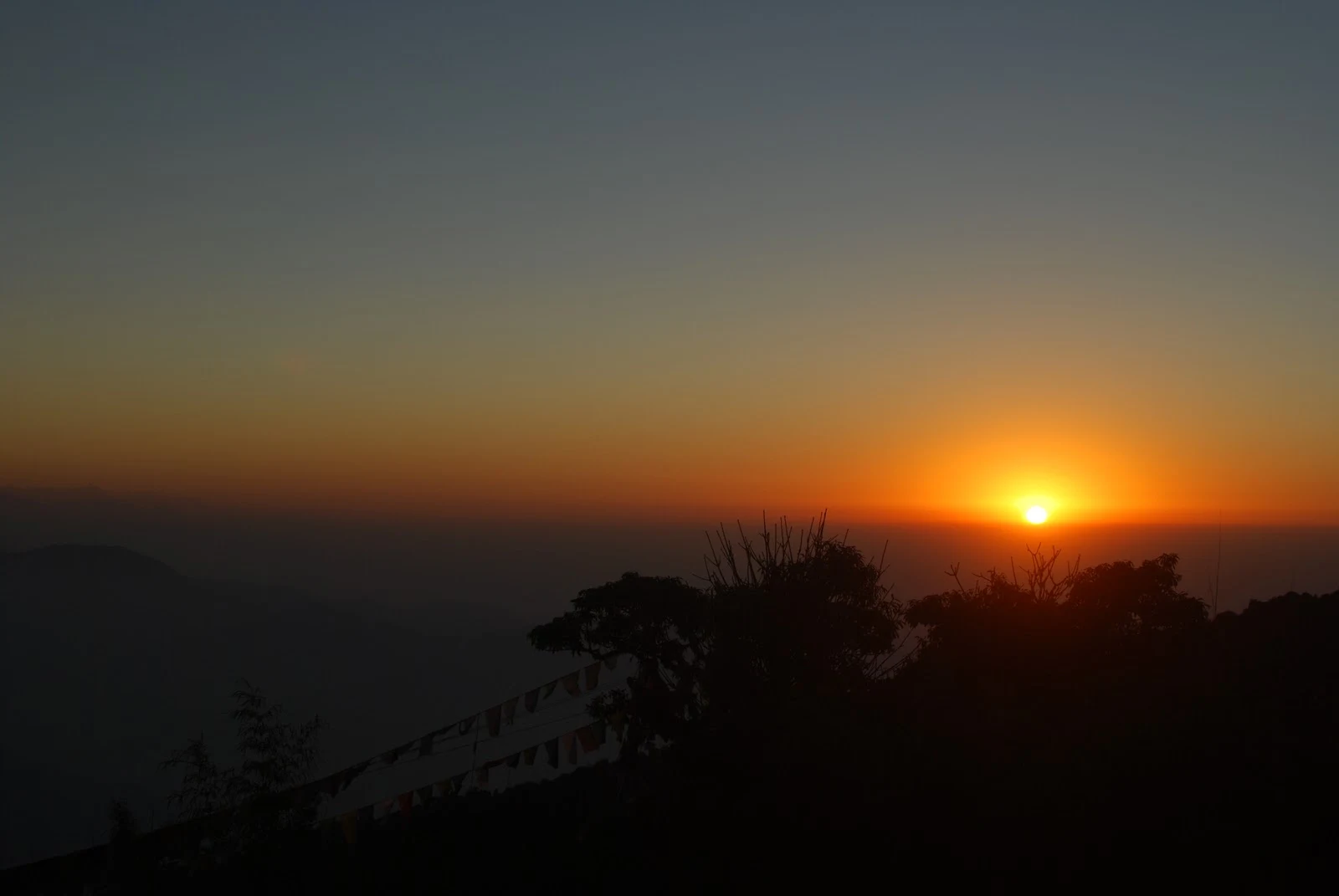
Then the sky begins. A thin grey line, then lemon, then rose along the horizon. The first peak to catch the light is Kanchenjunga, the third highest mountain on earth at about 8,586 metres, glowing a faint pink and then a deep gold as the sun reaches it. Whole crowds go quiet. Cameras click in a soft rattle. If the day is clear, Everest appears as a small pale shape far to the west. If clouds sit in the valleys, the peaks float above a sea of white, which is its own kind of miracle.
Not every morning delivers. Visibility is best from October to early December and from March to May. In the monsoon the view often vanishes into cloud. If you wake to rain, resist the urge to cancel the plan, because the mist can part within an hour, and sometimes the better view arrives later from Observatory Hill or the ridges near your hotel.
Plan for the queue as much as for the cold. In autumn and spring the line of taxis and shared jeeps starts to thicken at Jorebungalow junction well before four, so the safe departure from Mall Road in those seasons is around half past three, and a little earlier if you want a place at the railing. Past the Senchal sanctuary gate the viewing tower offers three tiers: open ground along the outer railing, where the wind and the crowd press in; a first-floor pavilion with some shelter; and a top-floor lounge with seats and the clearest sightline. Rates are revised every season, so treat the tiers as a choice of comfort and confirm the price at the counter. Three mornings of trying for this one sunrise, the folklore of the hill, the ticket tiers and the odds of fog season by season are all set down in our Tiger Hill sunrise account, and it is the one to read before you set the alarm.
Some mornings give nothing at all. The jeep climbs through the dark in a convoy of headlights, the crowd gathers at the railing in coats and blankets, and the sky turns from black to a flat, thick grey with no peak anywhere in it. Shared taxis make the disappointment easier, with strangers from other hotels trading jokes and warm tea, and you walk the rest of the circuit together on the return: the monastery at Ghum with its incense in the damp air, then Batasia Loop wrapped in mist. The cold on the hilltop stays in the bones for an hour, and so does the sense that the ritual itself, the dark drive and the shared silence, belongs to Darjeeling whether or not the mountains appear.
Batasia Loop and Ghum
On the way down, the taxi stops at Batasia Loop, about five kilometres from town. The railway here spirals around a small garden with a memorial to Gorkha soldiers, and the whole Kanchenjunga range spreads behind it in the morning light. Arrive early and the garden is nearly empty. Sellers of woollens and hot corn set up along the edges, and a tea stall pours small glasses to a handful of travellers. When the toy train arrives, steam rolling sideways in the wind, the whole loop becomes a painting that moves.
Ghum, a few minutes further, is the highest railway station on the line, at roughly 2,250 metres. A small railway museum sits beside the platform, and the Ghum Monastery nearby holds a giant Maitreya Buddha in a hush of butter lamps, incense and low chanting. Step in quietly and sit for a few minutes. The cold air outside and the warm butter-lamp glow within make a contrast that stays in memory longer than most views.
The Darjeeling Himalayan Railway, explained
The toy train is more than a ride. The Darjeeling Himalayan Railway runs on a two-foot narrow gauge, climbs from the plains to the hills through loops, reverses and zigzags, and was inscribed as a UNESCO World Heritage Site in 1999. Its small blue steam engines still work the Joy Ride, belching black smoke and white steam as they roll through the lanes of Darjeeling, so close to the shopfronts that you could almost pass a cup of tea through the window.
| Option | What it covers | Best for |
|---|---|---|
| Joy Ride (Darjeeling to Ghum and back) | A roughly two-hour round trip with a stop at Batasia Loop and time at Ghum station | Most visitors, photographers, families |
| Longer runs from NJP or Siliguri toward Darjeeling | The full climb through the hills at a slow, scenic pace | Rail enthusiasts with a full day to spare |
| Steam versus diesel haul | Steam is slower, more atmospheric and costs more; diesel is more dependable | Choose steam for the experience, diesel when the schedule matters |
Darjeeling Toy Train Ticket Booking, Step by Step
Tickets for the Darjeeling Himalayan Railway are sold through IRCTC. Create an account on the IRCTC website or app, search for the Darjeeling Joy Ride or the relevant NJP to Darjeeling service by train number, choose First Class or Chair Car, enter passenger details and pay online. Seats on the steam Joy Ride vanish quickly in October, November and the spring months, so book the moment the booking window opens for your date. If online seats are gone, the Darjeeling station counter sometimes releases a few seats, and early queues are the only way to find out.
The ride rewards the right seat. Choose a window on the side facing the valley when climbing out of town, and keep your camera ready for the moment the track curves around Batasia. Expect the diesel Joy Ride to sit around ₹1,000 a seat and the steam Joy Ride around ₹1,500, with the Vista coach edging a little higher; the figure shown on IRCTC when you book is the one that counts. Search with Darjeeling as both the starting and the ending station, because the Joy Ride returns to the platform it left. The line is also vulnerable to landslides. During heavy monsoon weeks, services are often suspended for stretches of track, and that is worth checking before you plan your days around it.
Toy train fares and timings at a glance
| Service | Approximate fare | Duration | Character |
|---|---|---|---|
| Joy Ride, diesel | Around ₹1,000 | About 2 hours | Reliable, cheaper, same route and stops |
| Joy Ride, steam | Around ₹1,500 | About 2 hours | Smoke, whistle and the heritage engine |
| Joy Ride, steam Vista coach | A little above the steam fare | About 2 hours | Wider windows for photographers |
| Kurseong to Darjeeling | Varies by class | About 2.5 hours | A quieter stretch of the line with few tourists |
| NJP to Darjeeling | Varies by class | About 7 hours | A full heritage day rather than a practical transfer |
Departures spread between mid-morning and mid-afternoon, and the exact slots change with the season, so look at the live timetable before choosing your day. The earliest departure gives the clearest air at Batasia Loop.
Classes and train numbers
| Class | IRCTC code | What to expect |
|---|---|---|
| First Class | FC | Fewer seats, more room, the cabin the photographers fight for |
| Chair Car | CC | Standard seating with wide windows and a livelier carriage |
The train number for your date appears on the IRCTC listing for the Darjeeling Himalayan Railway, and the Joy Ride, the steam-hauled departures and the diesel-hauled services each carry their own. Note the number and the departure time before you pay, because the Joy Ride and the longer runs from NJP or Siliguri are different journeys with different timings.
How the ride feels, hour by hour
The first few minutes belong to the town. The whistle sounds, the engine shudders and the carriage rolls out of Darjeeling station so close to shopfronts that shopkeepers lean back to let it pass, children run alongside, and a woman hanging washing on a balcony waves without looking up. Coal smoke blows in through the window, sharp and sweet at once.
Then the town loosens its grip. The track slides beside the road, crosses it, and begins to climb through pine and tea, the engine working hard, the wheels singing on the curves. At Batasia Loop the train swings in a slow circle around the memorial garden, and the whole Kanchenjunga range slides across the window like a curtain being drawn. By Ghum the air is thin and cold, the platform smells of woodsmoke and boiled eggs, and the guard lets everyone down to stretch their legs and stand in front of the little blue engine for photographs.
The return is quieter. People lean against the windows, watching the light drop on the hills, and the long downhill roll back into Darjeeling feels like the end of a lullaby.
Late morning: the zoo and the mountaineers
After the train, walk to the Padmaja Naidu Himalayan Zoological Park, home to the red panda, the snow leopard and the Himalayan wolf. The enclosures spread along a forested slope, so wear shoes with grip. Next door, the Himalayan Mountaineering Institute keeps a small museum of old ice axes, faded expedition photos and the equipment of those who tried the great peaks before modern gear existed. Tenzing Norgay lived and worked here after his Everest climb, and the quiet grounds give the place a gravity that cuts through the tourist bustle.
The zoo is worth a few minutes for one animal above all. The red panda enclosure sits near the entrance, and the animal inside never stops moving: up one trunk, along a branch, down another, a russet blur with a ringed tail that makes a photograph almost impossible. Stand quietly for a while and it comes close to the glass, curious and unbothered, a small creature that belongs to these forests and nowhere else.
Afternoon: tea and the gardens
Happy Valley Tea Estate sits on a slope just below town, and in the afternoon the light slants through the bushes and turns the leaves nearly gold. Pluckers move down the rows with baskets on their backs, thumbs and fingers working as fast as a sewing machine. Inside the small factory, the smell of withering leaf fills the room, sweet and grassy. A tasting here teaches you the difference between a spring flush that is light and floral, a summer second flush that is rounder and muscatel, and an autumn cup that is deeper and warmer.

The best way down to the tea country is by cable car. The gondola leaves the North Point station and slides out over the forest, the town shrinking behind you until the roofs look like scattered matchboxes and the tea rows below spread out in ordered green lines. At the bottom a cooperative tea factory opens its doors for a small fee, and a guide walks you through the withering racks, the rolling machines and the drying drums before leading you to a tasting table. The cups are fragrant and the tour ends, as these tours do, with a gentle sales pitch. Buy a small packet and the ride back up feels like an afternoon well spent.
Evening: Mall Road and the old cafés
As the sun drops, return to Chowrasta for the walk down Mall Road. At Keventer's, the old terrace café, the breakfast and sausage platters have been a ritual for generations, and the view over the rooftops from the upper deck is as good as any in town. Glenary's, a few steps along, serves cakes, pastries and a full dinner in a room warmed by a fireplace in winter. Order a pot of tea, sit by the window and watch the lights of Kalimpong appear on a distant ridge. Look for the Churpee, a hard fermented yak or cow milk cheese chewed slowly and sold in small packets, a local snack that tastes unlike anything from the plains.
A short walk from Chowrasta, a small market tucked into a side lane serves the cheapest and some of the best momos in town. Women lift the lids of bamboo steamers and clouds of steam roll out, dumplings stuffed with cabbage, minced meat or cheese are slid onto steel plates, and a bowl of fiery red chutney sits on every counter. A plate disappears in minutes, and then another, standing at the counter among office workers and schoolchildren on the way home.
By eight the town has quietened. Shutters come down along Mall Road, the last jeeps grind uphill and a cold hush settles over the ridge. Darjeeling goes to bed early, like a well-behaved Victorian, and the only sounds left are a dog somewhere below and the wind in the prayer flags.
Day Three: Slow Morning and Goodbye
Observatory Hill and Chowrasta at first light
A gentler morning belongs to Observatory Hill, the small hilltop above Chowrasta crowded with prayer flags and wild monkeys, and home to the Mahakal temple, where a Hindu shrine and a Buddhist altar share the same sacred ground. Walk up through the mist as the town wakes below. Shop shutters rattle open, milk vans pass, and a man sweeps leaves off the steps with a broom of twigs. If the clouds lift, the peaks stand in the north like a wall at the end of the street.
Beside the shrine at the top, a monk sits near a row of bells, and when he chants the sound is so deep and steady that it seems to hum in the stone. Prayer flags in every colour snap above him. Between chants you can hear only the cloth in the wind, and the long low note of a horn drifting up from the valley.
Not far away, Nightingale Park gives the mountains a quieter stage. Young girls in tracksuits jog and stretch in the cold light while the Kanchenjunga range stands behind them. Then comes the strangest thing about these peaks: the further you walk from the viewpoint, the larger they seem to grow, as if the mountains were rising behind you with every step.
Mall Road without a plan
The last morning is for browsing. Tibetan curio shops hold singing bowls, prayer wheels, turquoise jewellery and woollen shawls. Tea shops weigh Darjeeling leaf into paper packets and will let you smell each before buying. The Chowrasta bookshops, small and slightly musty, sell old maps and mountaineering memoirs. Buy a packet of first flush and one of second flush, so you can taste the difference at home.
The last afternoon at the Peace Pagoda
Save one afternoon for the Japanese Peace Pagoda. The walk there leads through pine and quiet lanes, and the white dome waits at the end of it in a hush that the town below cannot reach. Sit on the steps and let the hours go by. Monks in maroon pass with their prayer wheels, and as the sun drops the snow on Kanchenjunga turns from white to apricot to rose. Nobody speaks. Some travellers come to Darjeeling for the toy train and the tea, and leave remembering only this: an afternoon of silence in front of a mountain, which is what the hills have been offering all along.
The road down
Leaving Darjeeling feels like waking from a long dream. The jeep winds downhill through the same bends you climbed, the air thickens, the tea gardens fall behind, and by Siliguri the heat returns, flat and ordinary. A last glance back shows the ridge wrapped in cloud, as if the town had pulled a blanket over itself and gone back to sleep.
Places to Visit in Darjeeling, in the Order That Works
Darjeeling rewards a sensible sequence. The mountains belong to the early hours, the monasteries and museums to the middle of the day, the tea gardens to the long gold afternoon and the town itself to the evening. Follow the light and the plan arranges itself.
| Place | Best hour | What waits there |
|---|---|---|
| Tiger Hill | Before sunrise | Kanchenjunga turning pink, then gold, with Everest a faint shape on clear days |
| Batasia Loop | Early morning | The spiralling track, the Gorkha memorial and the full mountain range |
| Ghum Monastery | Morning | Butter lamps, low chanting and the giant Maitreya Buddha |
| Himalayan Mountaineering Institute and Padmaja Naidu Zoo | Late morning | Expedition relics, and the red panda and snow leopard among the pines |
| Japanese Peace Pagoda | Late afternoon | A white dome in a hush of pine, with soft light on the valley |
| Happy Valley Tea Estate | Afternoon | Pluckers in the rows and the smell of withering leaf in the factory |
| Rock Garden | Midday | A cascading waterfall and landscaped terraces on the hillside |
| Observatory Hill | Dawn | Prayer flags, a shared Hindu and Buddhist shrine and wandering monkeys |
| Chowrasta and Mall Road | Evening | The crowd, the shops, the mist drifting down the lanes |
| Rangeet Valley ropeway | Late morning | A slow glide from North Point down over forest and tea to the Singla riverbank; there is no online booking, the queue can stretch past an hour in season, and one day each month is kept for maintenance, so go early and confirm that it is running |
Entry timings and ticket details shift with the season, so confirm them at the gate or with your hotel on the morning you go.
More places worth the detour
Bhutia Busty Monastery sits a short downhill walk from Chowrasta, a Tibetan-style gompa with painted beams, butter lamps and a hush that feels a long way from Mall Road, and it holds a copy of the Tibetan Book of the Dead. Lloyd's Botanical Garden is a terraced slope of orchids, magnolias and old trees where the crowds thin and the light turns soft by mid-afternoon. The Bengal Natural History Museum, inside the zoo complex, is a hall of stuffed birds, butterflies and old specimens that rewards a rainy hour. Nightingale Park is a small garden where locals sit with a view toward the Kanchenjunga range, and Lamahatta Eco Park, a drive out through pine forest, is a place for slow walks and silence rather than ticking off sights.
Darjeeling Itinerary: 2, 3 and 5 Days
The 2-day version packs the mountains into the first morning: Tiger Hill at dawn, Batasia Loop, Ghum and the toy train before lunch, then Happy Valley in the afternoon and Mall Road at dusk. The second day is slower, with Observatory Hill at first light, the zoo and the Mountaineering Institute, a last cup of tea at Glenary's and the road down by afternoon.
| Day | 3-Day Plan | 5-Day Plan (adds) |
|---|---|---|
| Day 1 | Arrive, settle in, Chowrasta and Mall Road evening | Same, with a slower arrival and Observatory Hill walk |
| Day 2 | Tiger Hill sunrise, Batasia Loop, Ghum Monastery, toy train, zoo and HMI, Happy Valley | Same |
| Day 3 | Observatory Hill, Mall Road shopping, departure | Day trip to Mirik and its lake |
| Day 4 | – | Tea estate tour and tasting at Makaibari or Singtom |
| Day 5 | – | Short trek toward Tonglu or Tumling, then departure |
Best Time to Visit Darjeeling
October to early December. The sky scrubs itself clean after the monsoon, the peaks stand sharp and the air is crisp. This is the busiest and most expensive stretch, and it coincides with Durga Puja crowds, so book rooms and toy train seats early.
March to May. Rhododendrons flush red along the forest roads and the first tea flush is picked. Views are good in the mornings, with afternoon cloud common as summer approaches.
December to February. Cold and quiet, with frost on windows, woollens in every shop and a few days of exceptional clarity. Hotels with working heaters become worth every rupee, and some lower roads see morning fog that delays departures.
June to September. The monsoon wraps the town in cloud and rain. Landslides can cut roads and suspend the toy train, but the hills turn emerald, crowds thin and rooms cost less. Pack a rain jacket, shoes with proper grip and patience.
Month by month
| Month | Weather | Kanchenjunga visibility |
|---|---|---|
| January and February | Cold, frosty mornings, occasional snow on the higher ridges | Good on clear mornings |
| March and April | Mild, rhododendrons in bloom | Good in the morning, cloud by afternoon |
| May | Warm days, building cloud and the first showers | Fair, best at dawn |
| June to August | Heavy rain, fog, landslide risk | Poor, rare breaks |
| September | Rain easing, hills deep green | Improving |
| October and November | Crisp, dry and bright | Excellent |
| December | Cold and clear, a few foggy days | Very good |
Getting to Darjeeling
| From | How | Typical time |
|---|---|---|
| Bagdogra Airport (IXB) | Pre-paid taxi or shared jeep via Siliguri | About 3 to 4 hours |
| New Jalpaiguri (NJP) station | Shared jeep, taxi, or the toy train for rail enthusiasts | About 3 to 4 hours by road |
| Siliguri | Shared jeep stands to Darjeeling | About 3 hours |
Shared jeeps fill before leaving, so expect to wait if you arrive off-peak. A private taxi costs more but gives you control of the schedule and the luggage. Mountain roads can be slow after rain, so leave a buffer on the day of any onward flight or train.
Choosing between the options comes down to your luggage and your patience. A shared jeep is the cheapest seat uphill and the most sociable, with strangers swapping snacks and stories for four hours, but it leaves only when full and gives you little say over the stops. A private taxi costs several times more per head yet leaves when you do and pauses at tea stalls and viewpoints on request. The toy train from NJP or Siliguri is the slowest way up and the most memorable, and it suits travellers with a whole day to give to the climb. Ask for the current fare before you agree to any ride, and settle it before the engine starts.
What a Darjeeling Trip Costs
Darjeeling stretches to fit most budgets, and the biggest swing is the room. The sums below are approximate and move with the season, so use them to shape a plan rather than to fix a budget.
| Item | Approximate cost |
|---|---|
| Budget room | Under about ₹2,000 a night |
| Mid-range room or homestay | About ₹2,000 to ₹5,000 a night |
| Heritage or luxury room | Premium, several times the mid-range rate |
| Toy train Joy Ride | About ₹1,000 (diesel) or ₹1,500 (steam) per seat |
| Rangeet Valley ropeway | Roughly ₹200 to ₹260 per adult |
| Tiger Hill sunrise run | Taxi fare split among travellers, plus the tower ticket of your chosen tier |
| Batasia Loop and small gardens | A token entry fee at each gate |
The cheapest way to see the town is to share a taxi for Tiger Hill, Batasia Loop and Ghum with fellow guests, walk everything else, and eat at the momo counters and thali kitchens where the locals queue. The most memorable splurge is a steam Joy Ride seat on a clear morning followed by an afternoon with a pot of first flush on a heritage verandah.
Before You Go: Hill Station Realities
- Morning traffic. The roads in and out of Darjeeling clog early. Leave town before seven for a smoother descent.
- Winter heating. Many rooms have no central heating. Ask for a heater and confirm the geyser works before you book.
- Taxi and jeep luggage. Shared vehicles limit bag size. Pack light or pay for extra space.
- Walking-only lanes. Some hotels are reachable only on foot. Porters are available at the stand.
- Cash and ATMs. Machines in town run out of cash or go offline now and then. Carry enough notes for taxis and small shops.
- Mobile network. Signal can drop in the lanes and on the ridges, so download maps and bookings before you climb.
- Altitude. Around 2,000 metres is gentle for most travellers, though steep lanes can still leave you breathless on day one.
- Safety. The town is relaxed and walkable, though steep stairs turn slick in rain and some lanes are poorly lit after dark. Carry a small torch, wear shoes with grip and watch your step on wet stone.
- Tipping. Porters, drivers and hotel staff appreciate a small tip, and a modest extra for the driver after a long sunrise run is a courtesy that is well received.
- Sikkim and nearby areas. Onward trips toward Sikkim and border areas follow their own permit rules, which differ for Indian and foreign visitors.
What to Pack by Season
| Season | Pack |
|---|---|
| Winter (frost) | Thermals, a down jacket, woollen cap, gloves, thick socks, moisturiser and lip balm |
| Spring and autumn | Light layers, a fleece, a windcheater and a warm cap for sunrise |
| Monsoon | A rain jacket, grip-soled shoes, quick-dry clothes and a waterproof bag cover |
Festivals in the Hills
Losar, the Tibetan new year, arrives in the cold weeks of February or March, when monasteries hang fresh prayer flags, butter lamps burn through the night and the hills ring with horns and chanting. Durga Puja in October fills the town with pandals, drums, marigold garlands and the smell of frying sweets, and it also fills the hotels, so book well ahead. Both festivals change the mood of the hills, and a visit that lands on either carries a warmth that no ordinary weekend can match.
Nearby Day Trips from Darjeeling
Kalimpong brings flower nurseries, old monasteries and a quieter bazaar. Mirik offers a lake, pine slopes and tea gardens under a wide sky. Lava and Lolegaon are forest-wrapped villages with cool mornings. Sandakphu rewards trekkers with views of four of the five highest peaks on earth, and the ridge walk carries on to Phalut, at about 3,595 metres, before a long forest descent to the village of Gorkhey and its trekkers' hut. Pelling in Sikkim faces Kanchenjunga head-on from across the border.
The Singalila ridge trek is the longest answer Darjeeling has to the question of what to do next. The trail begins at Manebhanjan, climbs through rhododendron and oak forest, and spends its nights in simple trekkers' huts and village lodges where dinner is dal, rice and a hot cup of tea beside a wood fire. Mornings arrive icy and brilliant, with Kanchenjunga on one side of the ridge and the Everest range on the other, and the days stretch long between one hut and the next. Many walkers go as far as Sandakphu, others push on to Phalut and descend to Gorkhey, and a few turn the whole thing into a week that ends in Rimbik. The stays, the heights and the photographs for each leg are laid out in our posts on Sandakphu and Phalut.

Darjeeling FAQ
What is the best time to visit Darjeeling?
October to early December and March to May give the clearest Kanchenjunga views. Winter is cold and quiet. The monsoon brings fog and landslide risk.
How do I book the Darjeeling toy train?
Book through IRCTC by searching the Darjeeling Himalayan Railway Joy Ride or the NJP to Darjeeling service, choosing First Class or Chair Car, and paying online. Book early in peak season.
How many days are enough for Darjeeling?
Three days cover the essentials. Five days add Mirik, a tea estate tour and a short trek.
How do I reach Darjeeling from Bagdogra or NJP?
Take a shared jeep or taxi through Siliguri. The drive takes roughly three to four hours.
Where should I stay in Darjeeling?
Choose Mall Road and Chowrasta for walkability, Observatory Hill and the ridges for views, or a tea estate homestay for a slow stay.
Do I need a permit for Sikkim from Darjeeling?
Rules differ for Indian and foreign visitors and for restricted areas. Confirm the current requirement before you travel.
Is the Darjeeling toy train a UNESCO site?
Yes. The Darjeeling Himalayan Railway received UNESCO World Heritage status in 1999.
What should I pack for Darjeeling?
Layers year round, thermals and a down jacket in winter, a rain jacket and grip shoes in the monsoon.
Is the Darjeeling toy train running?
The Joy Ride runs on most days with steam and diesel departures. Heavy rain and landslides can suspend services for a few days, so check IRCTC and the station counter near your travel date.
Is Darjeeling crowded during Durga Puja?
Yes. Rooms, toy train seats and Tiger Hill jeeps fill early, so book ahead, travel on weekdays where you can and take the first departure of the day. The October skies are also the clearest of the year.
How much does the Darjeeling toy train ticket cost?
Around ₹1,000 for the diesel Joy Ride and around ₹1,500 for the steam Joy Ride. The fare on IRCTC at booking is the one that applies.
Darjeeling gives itself slowly. A whistle in the fog, a cup of pale gold tea, a prayer flag snapping in the wind, and one clear morning when the whole range lights up like a lantern. Come with time, come with warm clothes, and let the hills set the pace.
I'm not partial to cold weather or winter but your description of this "amazing paradise" has certainly sparked my curiosity and imagination.
Ah - superb shot!
beautiful foto...
Beautiful photos especially the first one!
What a beautiful photograph,
it looks amazing.
Just popped over from Eva's blog and am glad that I did
as your blog is lovely.
I will read more and become your latest follower.
Have a good Sunday
Fiona
What an amazing photo - so beautiful.
Friend really such a nice & beautiful place in India For you & your love one.......
Gorgeous shot.
Okay, I'm in love with your blog.
:)
What a beautiful place! Thank you for sharing!
lovely 1 THE PHOTOS ARE SUPERB AND THE POST IS JUST LOVELY!
Spectacular view.
Pretty - I studied in Darj for many years so was a nice trip down memory lane seeing these pics.
Thanks for visiting my blog. Appreciate your nice comment there.
I am from darjeeling so yes, very beautiful post :)
GASP. That's gorgeous!!
A true justice to Darjeeling's beauty...admirable work with the content and photographs...
Beautiful captures of Queen of hill stations in India...:)